Table of Contents
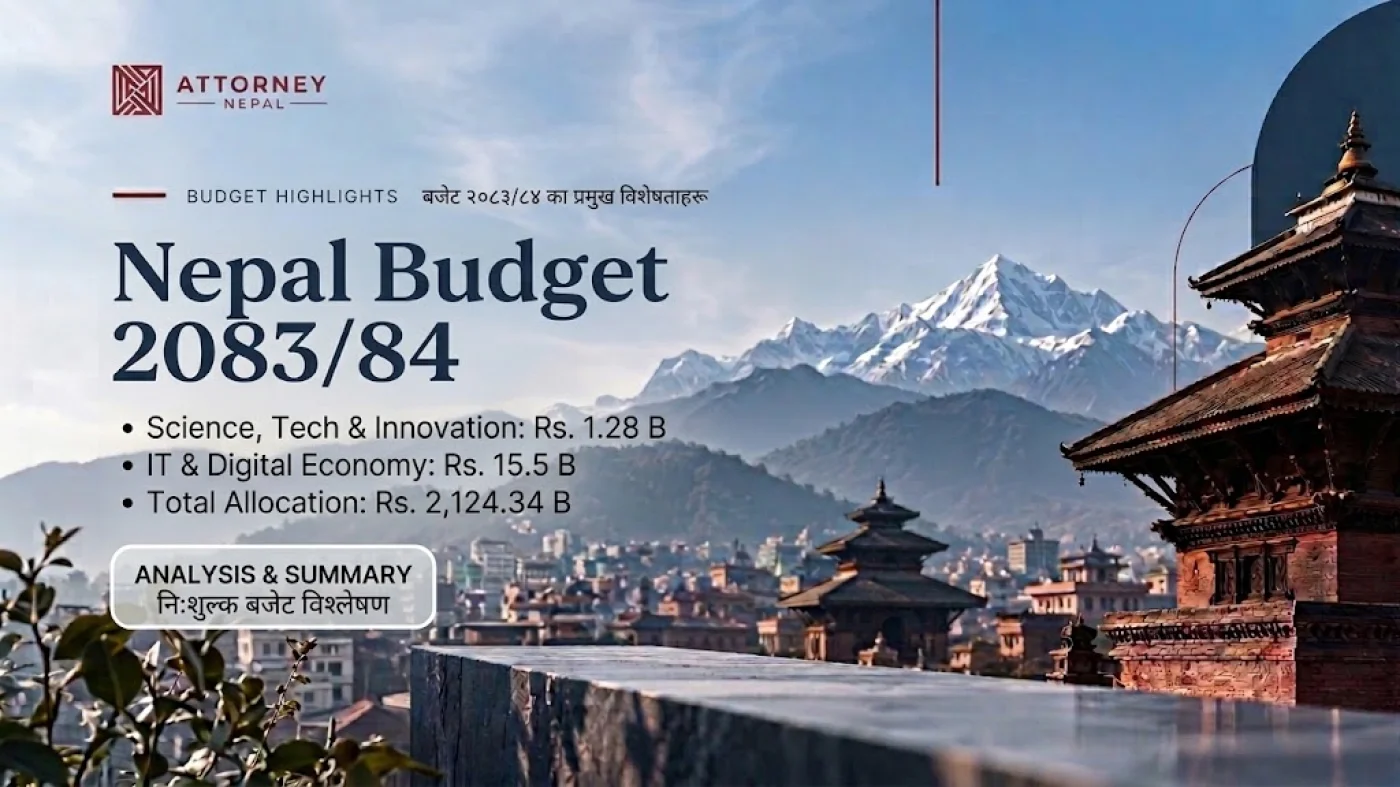
Nepal budget 2083/84 was unveiled by Finance Minister Dr. Swarnim Wagle on May 29, 2026, at a joint session of the Federal Parliament in Kathmandu, marking the first budget presentation of the Balendra Shah-led government after the Rastriya Swatantra Party secured an almost two-thirds majority in the March 2026 elections. The total budget outlay of Rs 2,124.34 billion (approximately Rs 2.12 trillion) is established by the government as the largest budget in Nepal's history, representing a 25.2 percent increase over the revised estimates of the current fiscal year 2082/83. Understanding the Nepal budget 2083/84 is considered essential by economic analysts because sweeping tax reforms, massive infrastructure allocations, and transformative sectoral policies are introduced by this budget that fundamentally reshape Nepal's fiscal landscape for the upcoming fiscal year beginning July 16, 2026. Furthermore, the budget targets 7 percent economic growth and inflation capped at 6 percent, ambitions that are framed by the Finance Minister as a departure from a decade of political instability toward productive governance. The Nepal budget 2083/84 also announces Nepal's first sovereign AI computing center, doubling of personal income tax exemption thresholds, 21 percent civil servant salary increases, and restructuring of the Nepal Electricity Authority into three separate companies. This comprehensive tutorial is designed by financial and legal experts to explain every dimension of the Nepal budget 2083/84 including macroeconomic targets, expenditure breakdown, revenue sources, tax reforms, sector allocations, infrastructure projects, and business implications. Moreover, the information presented herein is fact-checked thoroughly against official budget documents and updated as of May 30, 2026.
What Is Nepal Budget 2083/84?
Nepal budget 2083/84 is defined as the annual estimates of revenue and expenditure presented by the Government of Nepal for the fiscal year 2083/84 BS (2026/27 AD) under constitutional mandate requiring budget presentation on Jestha 15 every year. The budget is presented by Finance Minister Dr. Swarnim Wagle on behalf of the Council of Ministers and is approved by the Federal Parliament before implementation. Additionally, the Nepal budget 2083/84 encompasses recurrent expenditure for government operations, capital expenditure for infrastructure and development projects, and financial management for debt servicing and lending. The Economic Survey for fiscal year 2082/83 was presented by the Finance Minister on May 28, 2026, setting the economic context for the budget announcement. The Central Bureau of Statistics has stated that economic growth in the current fiscal year 2082/83 will be 3.85 percent, significantly below the ambitious 7 percent target set for the upcoming year. Consequently, the Nepal budget 2083/84 is regarded by observers as a reform-focused fiscal plan that prioritizes economic transformation, private sector empowerment, and structural overhaul of public institutions. Therefore, detailed analysis of the Nepal budget 2083/84 is essential for businesses, investors, civil servants, and citizens to understand how government resources are allocated and what policy changes affect their economic interests.
Macro-Economic Targets of Nepal Budget 2083/84
Specific macroeconomic targets are established by the Nepal budget 2083/84 to guide fiscal policy and economic planning. The following targets are announced by the Finance Minister:
- Economic Growth Rate: 7 percent GDP growth is targeted for fiscal year 2083/84, up from the projected 3.85 percent in the current fiscal year.
- Inflation Control: Inflation is targeted to be kept below 6 percent through monetary policy coordination and supply-side measures.
- Revenue Collection: Rs 1,405.31 billion is projected to be collected from domestic tax and non-tax revenue sources.
- Foreign Grants: Rs 61.74 billion is expected from foreign grant assistance.
- Foreign Loans: Rs 247.28 billion is planned to be mobilized from external borrowing.
- Domestic Borrowing: Rs 410 billion is targeted from internal debt, though Rs 245.89 billion of existing domestic debt must be repaid during the same year, making net new domestic borrowing approximately Rs 164.11 billion.
- Budget Deficit: The fiscal deficit of Rs 657.29 billion is planned to be financed through the combination of foreign loans and domestic borrowing.
Budget Expenditure Breakdown
The total expenditure of Rs 2,124.34 billion in the Nepal budget 2083/84 is allocated across three major categories. The following table details the expenditure structure:
| Expenditure Category | Amount (Rs Billion) | Percentage of Total Budget | Description |
|---|---|---|---|
| Current (Recurrent) Expenditure | 1,270.58 | 59.8% | Salaries, operations, debt interest, administrative costs |
| Capital Expenditure | 431.10 | 20.3% | Infrastructure, development projects, construction |
| Financial Management | 422.64 | 19.9% | Debt repayment, lending, financial transfers |
| Total Budget Outlay | 2,124.34 | 100% | Largest budget in Nepal's history |
The dominance of current expenditure at 59.8 percent is noted by economists as a persistent challenge in Nepal's budgeting pattern, though the government has positioned this budget as prioritizing productive investment. The capital expenditure allocation of Rs 431.10 billion represents a significant commitment to infrastructure and development if execution rates improve from historical levels of 70-80 percent absorption.
Major Tax Reforms in Nepal Budget 2083/84
Sweeping tax reforms are announced by the Nepal budget 2083/84 to ease burdens on businesses and middle-class families while simplifying compliance. The following table summarizes the key tax changes:
| Tax Reform Measure | Previous Provision | New Provision | Impact |
|---|---|---|---|
| Personal income tax exemption threshold | Rs 500,000 - 600,000 | Rs 1,000,000 | Significant middle-class relief; doubled in one year |
| Maximum personal income tax rate | Previous top rate | Reduced by 10 percentage points | Lower tax burden on high earners |
| Customs duty tiers | 11-tier structure | 7-tier structure | Simplified trade procedures |
| Customs duties on industrial raw materials | Various rates | Reduced on 273 categories; at least one tier below finished goods | Boost to domestic manufacturing |
| Excise duty | Abolished on 360 categories | Excise duty removed on 360 goods | Reduced production costs |
| Green levy (new) | Multiple scattered levies | Single unified levy at customs | Consolidated road maintenance and infrastructure fees |
| Capital gains tax on listed securities | Required separate settlement | Final tax; no additional settlement needed | Clarity for investors |
| VAT discount for digital payments | None | 10% VAT discount at billing point | Incentive for digital transactions |
| VAT refund system | Manual | Automated | Improved efficiency |
| Tax dispute settlement | Prolonged litigation | Pay 1% additional tax; penalties/interest waived | Faster resolution |
The income tax exemption doubling to Rs 1 million is identified by experts as an unprecedented middle-class relief measure in Nepal's fiscal history. Moreover, the reduction of customs duty tiers from 11 to 7 and abolition of excise duty on 360 goods represent the largest tax simplification attempted by any previous budget. The 10 percent VAT discount for digital payments is designed by the government to promote cashless transactions and expand the formal economy.
Sector-Wise Allocations in Nepal Budget 2083/84
Major sectoral allocations are made by the Nepal budget 2083/84 to prioritize development areas. The following table details key sector allocations:
| Sector | Allocation (Rs Billion) | Key Initiatives |
|---|---|---|
| Education | 218.30 | School infrastructure audit; increased medical education quotas; international university campuses; Open University for overseas Nepalis; residential schools for low-HDI communities |
| Health | 101.95 | 90% health insurance coverage target in 3 years; free childhood cancer treatment; 336 basic hospitals in 3 years; national food and drug administration; nursing night duty doubled |
| Social Security (consolidated) | 120.00 | Doubled Dalit child nutrition allowance (Rs 1,000/month); autism residential schools; gig worker formalization; voluntary social security opt-out campaign |
| Roads and Urban Infrastructure | 286.48 | 1,000 km blacktopping; 275 bridges; East-West Highway 4-lane upgrade (Rs 37.46B); Kathmandu-Tarai Fast Track (Rs 17.64B); Nagdhunga tunnel inauguration; electric buses |
| Energy | 85.54 | 1,040 MW new capacity (670 hydro + 370 solar); Upper Arun, Uttarganga, Chainpur Seti, Tamakoshi-5 acceleration; Budhigandaki construction; NEA unbundling; Rs 70B transmission lines |
| Agriculture | 46.92 | 40% capital subsidy for farmers investing Rs 20M+; Rs 32.46B fertilizer procurement; 80% crop insurance premium subsidy; agricultural bill for fair prices; land banks |
| Irrigation (combined) | Substantial | 15,800 hectares new irrigation; Sunakoshi-Marin Diversion (Rs 2.98B); Sikta +5,000 ha; Babai +1,066 ha; underground irrigation Rs 1.83B |
| Tourism | 7.34 | Visit Nepal Year 2029 preparation; Nepal Wellness Year 2027; wellness tourism rebranding; EU Air Safety List removal goal; Gautam Buddha and Pokhara airport PPP; new trekking routes |
| IT and Digital Economy | Significant | Sovereign AI Compute Centre (Syuchatar); 50% IT export tax exemption; Nepal Telecom partial privatization; fintech marketplace; Nagarik App integration; remote work legalization |
Civil Service and Salary Reforms
Significant changes are introduced by the Nepal budget 2083/84 for government employees. The following details are announced:
- Salary Increase: Civil servant salaries are increased by 10 percent on the base scale, with an additional 10 percent monthly performance incentive allowance, resulting in a combined effective increase of approximately 21 percent.
- Implementation Date: The new pay scale takes effect from mid-July 2026 (beginning of fiscal year 2083/84).
- Salary Range: Minimum monthly salary ranges from approximately Rs 40,000 to Rs 100,000 and above depending on grade.
- Military and Police: Similar improvements are proposed for the military, police, and teachers.
- Institutional Restructuring: Savings from streamlining 31 government bodies (abolished), merging 6 others, and restructuring 18 more are expected to help fund salary increases.
Energy Sector Transformation
Major energy sector reforms are announced by the Nepal budget 2083/84. The following initiatives are detailed:
- Generation Target: 1,040 megawatts of new generation capacity will be added, comprising 670 MW from hydropower and 370 MW from solar, bringing total installed capacity to 5,535 MW.
- Major Projects: Upper Arun (1,061 MW), Uttarganga (828 MW), Chainpur Seti (210 MW), and Tamakoshi-5 (99 MW) are to be accelerated with financial management and tendering to begin.
- Budhigandaki Storage Project: The 1,200 MW project will move toward construction under an empowered authority model.
- NEA Restructuring: Nepal Electricity Authority will be unbundled into three separate companies covering generation, transmission, and distribution.
- International Trading: Private sector companies will be allowed to trade electricity internationally, and new power purchase agreements will be signed on a "take or pay" basis.
- Transmission Investment: Rs 70 billion is separately allocated for transmission line construction.
Infrastructure and Transport Projects
Massive infrastructure allocations are made by the Nepal budget 2083/84. The following projects are prioritized:
- Roads: Approximately 1,000 kilometers of road will be blacktopped and 275 road bridges constructed during the year.
- East-West Highway: The 1,028-km highway will be upgraded to four lanes within five years, with Rs 37.46 billion allocated.
- Kathmandu-Tarai/Madhesh Fast Track: Rs 17.64 billion is allocated, with 40 bridges and 5.4 km of tunnel to be completed this year.
- Pushpalal Mid-Hill Highway: Completion is targeted within three years.
- Nagdhunga Tunnel: Connecting Kathmandu Valley westward, the tunnel will be inaugurated from July 2026.
- Urban Mobility: Electric public buses, charging stations, smart bus parks, and underground utility ducts are planned for Kathmandu.
- Road Maintenance: A nationwide campaign receives Rs 28.52 billion.
Agriculture and Food Security Initiatives
Significant agricultural support is provided by the Nepal budget 2083/84. The following measures are announced:
- Capital Subsidy: Farmers investing a minimum of Rs 20 million in agricultural or livestock production will receive up to 40 percent of initial capital as grants, tapering by 10 percentage points annually over four years.
- Fertilizer Procurement: Chemical fertilizer procurement is increased to Rs 32.46 billion, with a seasonal calendar to ensure supply during planting periods.
- Crop Insurance: Farmers will be provided crop insurance with up to 80 percent premium subsidy.
- Agricultural Bill: A bill will be presented to Parliament to guarantee fair prices, formalize farmer-buyer contracts, and establish support mechanisms.
- Land Banks: Land banks will be established at local government level to use idle government and reclaimed river land for farming.
- Farmer Identity Cards: Farmer identity cards and market-linked farming supported by cold storage and processing facilities are proposed.
Education Sector Reforms
Major education investments are made by the Nepal budget 2083/84. The following initiatives are detailed:
- Infrastructure Audit: A nationwide school infrastructure mapping and audit will be conducted.
- Medical Education Quotas: Quotas currently limited across medicine, nursing, and IT will be reviewed and significantly increased.
- Skills System: A demand-driven skills system linked directly to industry and labor market needs will be expanded, with formal recognition for skills acquired through migration and informal work.
- International Universities: Top-ranked international universities will be invited to open campuses in Nepal.
- Open University: Programs will be extended to Nepalis working abroad.
- Residential Schools: Schools will be opened for communities with low human development indicators, beginning with the Chepang community in Chitwan.
- University Autonomy: Universities will be given greater academic, administrative, and financial autonomy under a cost-sharing model.
Healthcare and Social Protection
Significant health and social protection measures are introduced by the Nepal budget 2083/84. The following details are announced:
- Health Insurance: 90 percent of Nepalis are targeted for health insurance coverage within three years, with Rs 15 billion allocated specifically for the program. Restructuring toward a single-payer model is planned.
- Childhood Cancer: Free treatment for childhood cancer is provided in government hospitals.
- Hospital Construction: 336 basic hospitals will be completed within three years.
- Medical Institutions: Tribhuvan University Teaching Hospital, National Academy of Medical Sciences, and Patan Academy of Health Sciences will be developed as internationally ranked institutions.
- Medicine Production: Nepal Medicine Limited will be empowered to produce at least 25 types of medicines currently provided free by the state.
- Nutrition Allowance: Dalit and child nutrition allowance is doubled to Rs 1,000 per month.
- Social Security Campaign: "Able ones should leave" policy encourages economically capable citizens to voluntarily forgo social security allowances.
- Street Children: A national declaration to make Nepal free of street children is announced.
AI and Technology Ambitions
Transformative technology commitments are made by the Nepal budget 2083/84. The following initiatives are detailed:
- Sovereign AI Compute Centre: Nepal's first AI computing center will be established at Syuchatar in Kathmandu, where thousands of AI processing units will be procured and offered to startups at concessional rates.
- AI Fellowships: 15 Nepali researchers currently contributing internationally in AI will be offered prestigious fellowships to return to Nepal.
- STEM Priority: Mathematics and related STEM subjects will receive higher priority in the education system.
- Sovereign Wealth Fund: A "Matribhumi Fund" will be established to invest in strategic assets including an "AI factory," with part of foreign exchange reserves channeled into technology infrastructure.
- IT Export Incentives: 50 percent income tax exemption on IT export earnings, and sweat equity for IT employees fully exempt from taxable income.
- Fintech Marketplace: A fintech marketplace will be established under Nepal Rastra Bank supervision.
- Remote Work Legalization: Laws enabling remote work for Nepalis working for foreign employers from within Nepal will be formalized.
- Nepal Telecom Partial Privatization: Shares will be sold to the public by mid-January 2027 while retaining 66 percent government ownership, with proceeds funding tech hub development.
Business and Investment Reforms
Major business environment improvements are announced by the Nepal budget 2083/84. The following reforms are detailed:
- Company Law Amendment: Conflict-of-interest provisions will be clarified and company dissolution simplified.
- Limited Liability Partnerships: A new law will be drafted to encourage angel investment, venture capital, and private equity.
- Foreign Apartment Ownership: Foreigners investing in Nepal will be allowed to lease apartments on a long-term basis (up to 25 percent of units in a building) in designated locations.
- Investment Express: An automated one-stop system will be operationalized within three months for company registration, financial services, tax compliance, and visa applications.
- Investment Board Projects: Projects approved by the Investment Board will no longer need separate approvals from other government bodies.
- Debt Recovery and IP Laws: Legal frameworks for debt recovery, intellectual property protection, and commercial dispute resolution through a dedicated tribunal will be developed.
- FITTA Revision: The Foreign Investment and Technology Transfer Act 2019 will be revised, removing the mandatory Nepal Rastra Bank permission requirement for profit repatriation.
- Start-up First-Loss Recovery: A first-loss recovery provision will be introduced for start-ups to encourage innovation.
- Offshore Bonds: Nepali currency offshore bonds will be introduced in foreign markets.
Financial Sector and Capital Market Reforms
Significant financial market changes are introduced by the Nepal budget 2083/84. The following reforms are announced:
- Nepal Stock Exchange Restructuring: Intra-day trading, short selling, and derivatives will be introduced in a phased manner.
- Global Depositary Receipts: Nepali companies listed on NEPSE will be allowed to issue GDRs for foreign stock markets.
- National Asset Management Company: Will be established by mid-January 2027 to deal with non-performing loans in the banking sector.
- Personal Credit Scoring: A personal credit scoring system will be introduced, and peer-to-peer lending will be regulated.
- Long-term Fixed Rates: Will be facilitated for agriculture, industry, tourism, and hydropower sectors.
- Capital Market Regulation: Zero-tolerance approach to share cornering and insider trading will be strengthened.
- Mandatory Insurance: Insurance will become mandatory for residential building construction, and third-party insurance coverage raised to Rs 1 million.
State-Owned Enterprise Reforms
Major restructuring of public enterprises is proposed by the Nepal budget 2083/84. The following changes are detailed:
- National Life Insurance Company: Shares will be publicly offered for the first time.
- Bishal Bazar Company: Shares will be publicly offered.
- Nepal Telecom: Shares sold to public by mid-January 2027, retaining 66 percent government ownership.
- Nepal Airlines Corporation: Will be converted into a company and a strategic partner identified.
- Rastriya Banijya Bank: Will receive additional government capital.
- Gorkhali Rubber Industry: Due diligence and asset-liability assessment for PPP model.
- Seven Public Enterprises: DDA will be completed in the next fiscal year for possible PPP resumption.
- Hydroelectricity Investment and Development Company: Will be merged with a compatible financial institution for specialized infrastructure financing.
Provincial and Local Government Transfers
Substantial fiscal transfers are provided by the Nepal budget 2083/84 to sub-national governments. The following table details the transfer structure:
| Transfer Type | Provincial Government (Rs Billion) | Local Government (Rs Billion) | Total (Rs Billion) |
|---|---|---|---|
| Equalization Grants | 61.50 | 90.20 | 151.70 |
| Conditional Grants (Federal Projects) | 49.72 | 206.80 | 256.52 |
| Supplementary Grants (Infrastructure) | 4.60 | 8.93 | 13.53 |
| Special Grants | 3.82 | 9.40 | 13.22 |
| Revenue Sharing | Through revenue sharing mechanism | Through revenue sharing mechanism | 175.00 |
| Total Transfers | Significant portion of budget | Significant portion of budget | Over 600 |
A "Governance Innovation Challenge Fund" will be established to reward provincial and local governments that innovate in service delivery. Overlapping functions across three tiers of government will be reviewed and legal clarification provided to resolve double-taxation disputes.
Tourism and Aviation Reforms
Major tourism initiatives are announced by the Nepal budget 2083/84. The following measures are detailed:
- Visit Nepal Year 2029: Intensively prepared for with rebranding around "wellness tourism" including yoga, meditation, Buddhist and Vedic philosophy, and high-altitude health experiences.
- Nepal Wellness Year 2027: Announced as a precursor to Visit Nepal Year.
- Civil Aviation Restructuring: The Civil Aviation Authority will be restructured by mid-January 2027 to separate regulatory and operational roles, aiming to remove Nepal from the EU Air Safety List.
- Airport PPP: Gautam Buddha International Airport and Pokhara Regional Airport will be managed in partnership with the private sector.
- New Trekking Routes: A "Danfe Route" connecting Khaptad, Rara, Swargadwari, and Muktinath will be established. Previously unnamed peaks above 6,000 meters will receive official Nepali names and be commercially promoted.
Recent Updates and Implementation Timeline
The Nepal budget 2083/84 was presented on May 29, 2026, and is scheduled for implementation from July 16, 2026. The following timeline is established:
- May 28, 2026: Economic Survey for FY 2082/83 presented to Parliament.
- May 29, 2026: Budget speech delivered by Finance Minister Dr. Swarnim Wagle at 4:00 PM in joint session of Federal Parliament.
- July 16, 2026: Fiscal year 2083/84 begins; budget implementation starts.
- Mid-January 2027: Nepal Telecom share sale to public; Civil Aviation Authority restructuring; National Asset Management Company establishment.
- Within 3 Months: Investment Express one-stop system operationalization.
- Within 3 Years: 90 percent health insurance coverage; 336 basic hospitals completed.
- Within 5 Years: East-West Highway four-lane upgrade completed; Pushpalal Mid-Hill Highway completed.
Frequently Asked Questions About Nepal Budget 2083/84
Q1: What is the total size of Nepal budget 2083/84?
The total budget outlay is Rs 2,124.34 billion (approximately Rs 2.12 trillion), the largest in Nepal's history, representing a 25.2 percent increase over the revised estimates of the current fiscal year.
Q2: Who presented Nepal budget 2083/84?
Finance Minister Dr. Swarnim Wagle presented the budget on May 29, 2026, on behalf of the Balendra Shah-led government.
Q3: What is the economic growth target for FY 2083/84?
The government targets 7 percent economic growth, up from the projected 3.85 percent in the current fiscal year 2082/83.
Q4: What are the major tax reforms in Nepal budget 2083/84?
Major reforms include doubling the personal income tax exemption to Rs 1 million, reducing the maximum personal income tax rate by 10 percentage points, simplifying customs duties from 11 tiers to 7, abolishing excise duty on 360 goods, and introducing a 10 percent VAT discount for digital payments.
Q5: How much will civil servant salaries increase?
Civil servant salaries will increase by approximately 21 percent effective mid-July 2026, comprising a 10 percent base scale increase and a 10 percent performance incentive allowance.
Q6: What is the Sovereign AI Compute Centre?
Nepal's first AI computing center will be established at Syuchatar in Kathmandu, procuring thousands of AI processing units to offer concessional computing rates to startups and entrepreneurs.
Q7: What energy sector changes are announced?
The Nepal Electricity Authority will be unbundled into three companies (generation, transmission, distribution). 1,040 MW of new capacity will be added, and private companies will be allowed to trade electricity internationally.
Q8: What infrastructure projects are prioritized?
Key projects include East-West Highway four-lane upgrade (Rs 37.46B), Kathmandu-Tarai Fast Track (Rs 17.64B), Nagdhunga tunnel inauguration, 1,000 km road blacktopping, and 275 bridge constructions.
Q9: What are the health sector allocations?
Rs 101.95 billion is allocated for health, including Rs 15 billion for health insurance, free childhood cancer treatment, 336 basic hospitals in three years, and development of internationally ranked medical institutions.
Q10: What business reforms are introduced?
Reforms include Investment Express one-stop system, FITTA revision for easier profit repatriation, foreign apartment ownership in designated locations, limited liability partnership law, and commercial dispute resolution tribunal.
Q11: What is the budget deficit and how will it be financed?
The fiscal deficit of Rs 657.29 billion will be financed through Rs 247.28 billion in foreign loans and Rs 410 billion in domestic borrowing.
Q12: What social protection measures are included?
Measures include doubled Dalit child nutrition allowance (Rs 1,000/month), "able ones should leave" social security campaign, autism residential schools, and national declaration to make Nepal free of street children.
References
The following authoritative sources are referenced by this guide and are recommended for further verification of the Nepal budget 2083/84:
- Ministry of Finance Nepal — Official budget speech and full text of fiscal year 2083/84 estimates.
- The Himalayan Times — Comprehensive budget coverage and sector analysis.
- Nepal News — Detailed budget explainer and reform breakdown.
- Ratopati English — Budget highlights and key announcements.
- Fiscal Nepal — Tax reform analysis and fiscal policy updates.
- Nepal Press — Official budget presentation coverage.
- Reuters Connect — International wire service budget reporting.
- DevPulse — Development sector budget analysis.
- Attorney Nepal PVT LTD — Expert budget analysis, tax compliance, and business advisory services.
Disclaimer
The information presented is intended for general educational purposes only and does not constitute legal, financial, or tax advice. The Nepal budget 2083/84 provisions are subject to amendment by the Federal Parliament and implementation details may be revised by the Government of Nepal. Readers are strongly advised to consult qualified tax professionals, financial advisors, and verify current regulations directly with official government sources before making business or investment decisions. Attorney Nepal PVT LTD shall not be held liable for consequences arising from reliance on this information. This content is updated as of May 30, 2026.
Also Read
1. How to get Business Visa in Nepal?
2. Foreign Branch office registration in Nepal?
This article is for general informational purposes only and does not constitute legal advice. For advice on your specific situation, please contact Attorney Nepal directly.