
Table of Contents
A business visa in Nepal is the legal foundation on which every foreign investor, founder, and authorized representative builds their presence in the country. Without this visa, no foreign national can lawfully establish a company, manage an investment, attend to commercial operations, or oversee a project inside Nepal. Yet the process remains confusing for most applicants. Rules were tightened in 2022, fees are linked directly to investment size, and approvals must be obtained from multiple authorities before the Department of Immigration will issue a single stamp.
This guide explains the business visa in Nepal in complete, practical, and exhaustive detail. It covers the legal framework, eligibility rules, the full document checklist, the investment-based fee schedule, the staged recommendation process introduced in 2022, timelines, renewal obligations, dependent visas, tax considerations, compliance duties, and the common mistakes that delay or destroy applications. Everything is written for investors, founders, and their advisors who need accurate, current information before committing time and capital to Nepal.
What Is a Business Visa in Nepal and Why Is It Essential for Foreign Investors?
Legal Meaning of the Business Visa Category
A business visa in Nepal is a long-stay visa category issued by the Department of Immigration (DOI) to foreign nationals who carry out approved business, trade, industrial, or investment activity in Nepal. It is not a casual visitor visa, and it is not a general work permit. It is a legal status tied directly to a documented commercial basis inside the country, and it remains valid only while that basis remains genuine, active, and compliant.
Under the Immigration Act 2049 (1992) and the Immigration Rules 2051, the business visa is issued for a minimum of one month and a maximum of five years at a time. In standard practice, the DOI grants a one-year multiple-entry visa with annual renewal, while five-year visas are reserved for established investors with proven operational track records in Nepal. The visa is granted on the recommendation of the Department of Industry or another authorized line agency, which means that immigration status is always derivative of investment status.
Why the Business Visa Matters More Than Most Applicants Realize
Many foreign nationals assume that a tourist visa is sufficient for exploratory business visits, and technically, short meetings and market research can be conducted on a tourist visa. However, the moment activity crosses into establishing a company, signing operational agreements, hiring staff, or managing day-to-day affairs, the correct category becomes mandatory. A business visa in Nepal is therefore not a formality. It is the single document that converts an investment from a paper transaction into a lawful operational presence. Banks, tax authorities, landlords, and regulators all treat the visa as evidence that the foreign principal is properly documented.
Who Must Obtain a Business Visa in Nepal?
| Applicant Type | Business Visa Needed? | Alternative Route |
|---|---|---|
| Foreign investor or promoter | Yes | Residential visa if USD 100,000+ invested at one time |
| Authorized company representative | Yes | Sponsored by the investing company |
| Company director or shareholder | Yes | Based on shareholding proof |
| Foreign employee of a local company | No | Non-tourist visa with labour permit |
| Short-term meeting attendee | Usually no | Tourist visa covers short exploratory visits |
| Exporter or trader based in Nepal | Yes | With DOI recommendation |
| Project coordinator for foreign company | Yes | With line agency recommendation |
| Franchise or technology licensor | Yes | With DOI recommendation |
Business Visa in Nepal vs Tourist Visa and Work Visa: Understanding the Categories
Why Category Confusion Causes Refusals
The most common strategic error made by foreign nationals is applying under the wrong category. The three categories most often confused are the tourist visa, the business visa, and the non-tourist visa. Each serves a different legal purpose, and mixing them creates both immigration risk and tax complications.
| Feature | Tourist Visa | Business Visa | Non-Tourist Visa |
|---|---|---|---|
| Purpose | Travel, sightseeing, short meetings | Investment, trade, business management | Employment, study, volunteer work |
| Basis | No local sponsor required | DOI recommendation | Employer or institution sponsorship |
| Maximum stay | 150 days per visa year | 5 years per issuance | Tied to employment contract |
| Work allowed | No | Business activity only | Only with labour permit |
| Renewal | At DOI | At DOI with documents | At DOI with employer papers |
A tourist who quietly runs a business is in violation. A business visa holder who takes a salaried job with an unrelated employer is also in violation. The business visa in Nepal must match the actual activity performed, and any change in activity should trigger a category review with an immigration lawyer.
Legal Framework Governing Business Visa in Nepal
Core Statutes and Regulations
The business visa in Nepal is governed by a layered legal framework that has been built up over three decades. The Immigration Act 2049 provides the foundational rule that no foreign national may enter or remain in Nepal without a valid passport and an appropriate visa. The Immigration Rules 2051 define the visa categories, including the business visa, and prescribe the general conditions of issuance. The Immigration Procedure 2065 governs operational processing, documentation standards, and enforcement mechanics. For investment-linked cases, the Foreign Investment and Technology Transfer Act 2019 and the Public-Private Partnership and Investment Act 2019 determine which authority issues the recommendation on which the visa depends.
Regulatory Authorities Involved in the Process
| Authority | Role |
|---|---|
| Department of Industry (DOI) | Recommendation letter for most investors |
| Investment Board Nepal (IBN) | Recommendation for large projects (above NPR 6 billion) |
| Department of Immigration (DOI) | Visa issuance, renewal, cancellation |
| Inland Revenue Department | Tax registration and clearance verification |
| Office of Company Registrar | Company registration verification |
| Nepal Rastra Bank | Foreign investment injection verification |
| Line ministries | Sector-specific recommendations where applicable |
Since 2022, the business visa system has been deliberately tightened to prevent misuse, including the use of business visas as substitutes for work permits or as parking status for non-investors. Under the revised practice administered through the Department of Industry, the recommendation is issued in stages. An initial three-month recommendation is granted first, during which the investor must complete company registration. A further three-month extension follows once the registration certificate is produced, during which tax registration and a corporate bank account must be opened. Continued progress on industry registration must then be demonstrated before longer-term extensions are recommended. The full long-term business visa in Nepal is issued only after the compliance chain is complete.
Eligibility Criteria for a Business Visa in Nepal
Core Eligibility Requirements
Eligibility for a business visa in Nepal is built on one central principle: the applicant must have a genuine, documented, and approved commercial basis in Nepal. The following conditions must generally be satisfied before any recommendation will be issued.
- The applicant must hold a valid passport with adequate remaining validity.
- A recommendation letter must be issued by the Department of Industry or the relevant line agency.
- Foreign investment approval must have been obtained where the business involves foreign capital.
- The company must be registered, or registration must be in verifiable progress.
- Tax registration must be completed and current.
- Shareholding or authorization documents must prove the applicant's real connection to the business.
- The applicant must not have violated Nepali immigration law in the past in a way that bars issuance.
Who Qualifies as an Investor or Representative?
Foreign investors in Nepalese trade or industry qualify directly. Authorized representatives of foreign companies also qualify, provided a notarized authorization letter is submitted along with the application. Shareholders with a documented stake, directors named in company records, and promoters of registered ventures may apply. In each case, the Department of Industry verifies that the person's role is real and active rather than nominal. A person holding one token share with no operational function is unlikely to survive scrutiny under the post-2022 rules.
Business Visa Fees in Nepal: Complete Investment-Based Schedule
How the Fee Structure Works
The fee for a business visa in Nepal is not a single fixed number. It is scaled according to the size of the foreign investment committed and made in the company. The logic is straightforward: larger verified investments are rewarded with lower fees, and in the highest slab, the visa is issued free of cost. The schedule below reflects the standard published rates, although minor revisions occur and should be confirmed with the DOI before payment.
| Investment Amount | Monthly Fee | Annual Fee | Five-Year Fee |
|---|---|---|---|
| Less than NPR 10 million | USD 35 | USD 400 | USD 1,000 |
| NPR 10 million to NPR 100 million | USD 20 | USD 200 | USD 500 |
| NPR 100 million to NPR 1 billion | USD 10 | USD 100 | USD 300 |
| NPR 1 billion or more | Free of cost | Free | Free |
Practical Points About Fees
Three details deserve attention. First, where the investment exceeds NPR 10 million, shareholding details must be submitted with the application so the correct slab can be verified. Second, the same fee schedule generally applies to dependents of the principal visa holder, which should be budgeted when planning a family relocation. Third, fees are normally payable in foreign currency, and receipts must be preserved because they are required at every renewal.
Comparison with the Residential Visa Option
Foreign investors who inject more than USD 100,000 at one time in convertible foreign currency may apply for a residential visa instead, which is granted on the recommendation of the Department of Industry for one year at a time. The residential visa carries a higher fee, generally USD 700 for the first year and USD 1,200 per renewal, but it provides a residence-based status rather than a business-based one. The correct choice between the two depends on the investor's long-term plans, tax position, family situation, and whether the business entity will remain the center of their activity. An immigration lawyer can model both options before the investment is structured.
Documents Required for a Business Visa in Nepal: The Complete Checklist
Primary Documents for First Application
The business visa in Nepal application is document-heavy, and most delays are caused by incomplete files rather than legal objections. The following checklist should be treated as the minimum standard for a first application after company establishment.
| Document | Issuing Authority |
|---|---|
| Recommendation letter from DOI or line agency | Department of Industry |
| Foreign investment approval letter | DOI / IBN |
| Company registration certificate | Office of Company Registrar |
| Memorandum and Articles of Association | OCR |
| Industry registration certificate | DOI |
| Shareholder register (certified copy) | OCR |
| Share details for investments above NPR 10 million | Company records |
| PAN/VAT registration certificate | Inland Revenue Department |
| Latest tax clearance certificate | IRD |
| Bank statement of the active company account | Commercial bank |
| Audit report, balance sheet, or progress report | Company / auditor |
| Notarized passport copy with latest visa | Notary public |
| Bio-data of the applicant (first-time applicants) | Self-prepared |
| Notarized authorization letter (for representatives) | Investing company |
| Monitoring report from DOI | Department of Industry |
| Passport-size photographs | Standard specification |
Documents for Annual Renewal
Renewal files are lighter but still demanding. A fresh DOI recommendation, current tax clearance, updated bank statements, the latest company filings, and the previous visa endorsement are the core items. If any of these has lapsed, the renewal will be refused regardless of how long the investor has held the visa.
Translation and Notarization Standards
All foreign-language documents should be translated into English or Nepali, and certified translation is recommended. Notarization is expected for passport copies and authorization letters. Where documents originate abroad, legalization or apostille may be requested depending on the mission handling the file. Documents that are improperly notarized are treated as absent, which is one of the most common causes of file rejection.
How to Get a Business Visa in Nepal: Full Step-by-Step Process
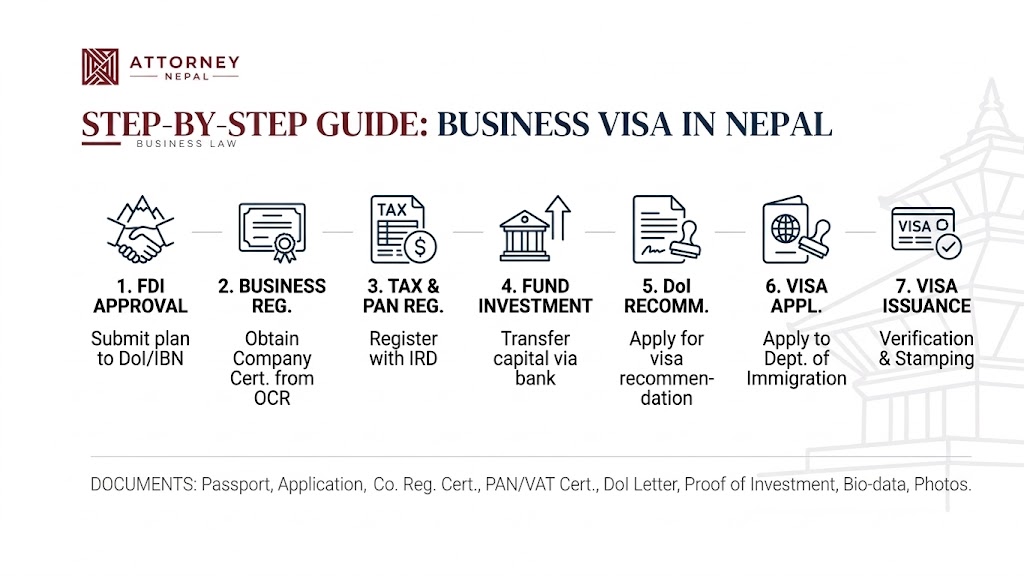
Stage One: Entry and Strategic Planning
The process for a business visa in Nepal begins after entry into the country. Nepal requires most foreign nationals to enter on a tourist visa first, because non-tourist categories generally cannot be applied for from overseas. After arrival, the category is converted once the supporting approvals are in place. Smart applicants use the tourist visa period to select legal counsel, finalize the investment structure, and begin company registration immediately.
Stage Two: Company Registration and Investment Approval
Before the visa file can move, the underlying business must be structured correctly. Company registration at the OCR, foreign investment approval from the DOI, tax registration, and a corporate bank account must all be completed or be in documented progress. Under the staged system introduced in 2022, the initial DOI recommendation of three months is granted on the basis of the investment approval, and extensions follow as each milestone is evidenced. Missing a milestone means waiting for the next recommendation cycle, so the sequence must be managed actively.
Stage Three: Building the Recommendation File
The recommendation file is the heart of the application. It demonstrates to the Department of Industry that the investment is genuine, the company is real, and the applicant is the correct person to hold the visa. Weak files produce short recommendations and repeated requests for additional documents. Strong files produce smooth progression to the long-term visa.
Stage Four: DOI Submission and Visa Issuance
The formal application for a business visa in Nepal is submitted to the Department of Immigration at Kalikasthan, Kathmandu, or the Pokhara branch, with the recommendation letter attached. An inspection of the business premises may be conducted before issuance. The DOI reviews the file, verifies the investment and registration documents, and issues the visa after fee payment.
- Obtain foreign investment approval from the DOI or IBN.
- Register the company and open the corporate bank account.
- Complete tax registration and obtain the PAN certificate.
- Secure the staged DOI recommendation letter.
- Prepare the full document file with notarized copies.
- Submit the application at the DOI visa section.
- Attend the premises inspection if scheduled.
- Pay the visa fee according to the investment slab.
- Receive the visa endorsement and verify every printed detail.
- Calendar the renewal date and set compliance reminders.
Timeline Expectations
The recommendation letter from the DOI or concerned line agency typically takes three to four weeks to obtain, depending on document quality and departmental workload. The visa itself is generally issued within five working days of a complete submission at the Department of Immigration. Applicants should plan for a total timeline of one to two months from entry to visa endorsement, and longer where company registration is still pending or where the file requires correction.
Business Visa Renewal, Validity, and Compliance Obligations
Validity and Renewal Cycle
A business visa in Nepal is issued for a minimum of one month and a maximum of five years. The standard practice is a one-year multiple-entry visa with annual renewal. Renewal requires a fresh recommendation letter, updated tax clearance, current company documents, and proof that the business remains active and compliant. A visa that is not renewed before expiry converts into an overstay situation, with daily fines and possible deportation consequences, so renewal should be started at least one month before expiry.
Ongoing Compliance Duties
Holding the visa creates continuing obligations. The company must maintain its annual filings, tax clearances, shareholder records, and operational activity. The investor must keep the DOI informed of material changes in shareholding or directorship. Failure to maintain the underlying business in good standing results in non-renewal, even if the visa fee is paid on time. The business visa in Nepal is therefore a reflection of the company's compliance health, not a standalone permit, and it should be managed with the same discipline as the company's tax and corporate filings.
Dependent and Family Provisions
Spouses and dependent children of the principal visa holder may obtain linked visas on the same fee schedule. School enrollment, medical care, and long-term residence all become easier once the family's status is regularized. Family files should be prepared together with the principal application so that renewals can be synchronized and no dependent accidentally falls into overstay.
Common Mistakes That Delay or Destroy Business Visa Applications
Frequent Errors Seen in Practice
| Mistake | Consequence |
|---|---|
| Applying before investment approval is issued | Application returned without review |
| Nominal or inactive shareholding | Credibility doubts and refusal |
| Expired tax clearance certificate | Automatic rejection |
| Missing notarization or translation | File deemed incomplete |
| Agent-prepared documents the applicant cannot explain | Interview failure |
| Confusing business visa with work visa | Wrong category and reapplication |
| Letting the visa lapse before renewal | Overstay fines and record damage |
| Failing to update DOI on shareholding changes | Recommendation refused |
| Weak or dormant company with no operations | Non-renewal at first annual review |
| Paying fees in the wrong currency or without receipts | Processing delays |
Most of these errors are preventable. The most reliable strategy is to build the compliance file continuously from the first day of company registration, so the visa renewal becomes a routine administrative step rather than an annual emergency.
Conclusion and Call to Action
The business visa in Nepal is the gateway through which every serious foreign investor must pass. The rules are demanding, the documentation is extensive, and the staged compliance system introduced in 2022 means that investors are now reviewed continuously rather than once at entry. Investors who build their company registration, tax, and banking records correctly from day one move through the process smoothly and renew without friction. Investors who treat paperwork as an afterthought face delays, refusals, and avoidable cost.
If you are planning to invest in Nepal, or if your current business visa file needs expert handling, professional guidance will save you months. Attorney Nepal Pvt. Ltd. provides complete business visa support, including DOI recommendation files, company registration, investment approval, document preparation, renewals, dependent visas, and ongoing compliance advisory. Contact our team today for a confidential consultation, and let your investment in Nepal begin on a fully lawful foundation.
References
For verification and further reading, the following sources are recommended:
- Department of Immigration Nepal – Official Website
- International Trade Administration – Nepal Business Travel Guide
- UNCTAD Investment Policy Monitor – Nepal Business Visa Restrictions 2022
- Federation of Nepalese Chambers of Commerce and Industry – FDI and Visa FAQ
- Attorney Nepal Pvt. Ltd. – Official Website
Disclaimer: This article is provided for general informational purposes only and does not constitute legal advice. Visa fees, procedures, and investment thresholds in Nepal are revised periodically by the Department of Immigration and the Department of Industry. Readers are advised to confirm current requirements with the relevant authorities or consult a licensed attorney before taking action.
Frequently Asked Questions
The Department of Immigration issues the visa on the recommendation of the Department of Industry or the relevant line agency, such as the Investment Board Nepal for large projects
There is no fixed minimum investment, but the visa fee is scaled by investment size, and investments below NPR 10 million attract the highest fee slab.
Approximately three to four weeks for the recommendation letter and about five working days at the Department of Immigration after a complete file is submitted.
In most cases, no. Foreign nationals enter on a tourist visa and convert to the business category after the supporting approvals are completed inside Nepal.
Yes, business visas are generally issued as multiple entry, which should be confirmed on the visa endorsement.
Yes, dependents of the principal visa holder can obtain linked visas, generally on the same fee schedule
No. The visa authorizes activity tied to the approved business basis. General employment requires a non-tourist visa with a labour permit.
The basis of the visa disappears, and renewal will be refused. The holder should either restructure the business or change visa category before expiry.
Yes, if a qualifying one-time investment of more than USD 100,000 is made, a residential visa may be applied for on DOI recommendation.
For investments below NPR 10 million, the five-year fee is USD 1,000. For investments between NPR 10 million and NPR 100 million, it is USD 500, with lower or zero fees at higher investment levels.
Government fees are generally not refundable once processing has begun, which is why document preparation before submission matters so much.
No full-time residence requirement is imposed, but the underlying company must remain active and compliant, and extended absence should be explained in the renewal file.
This article is for general informational purposes only and does not constitute legal advice. For advice on your specific situation, please contact Attorney Nepal directly.