Table of Contents
The divorce process in Nepal is a legally recognized judicial procedure through which a valid marriage is formally dissolved between husband and wife. This process is governed primarily by Sections 93 to 104 of the Muluki Civil Code 2074 (2017) and the procedural rules contained in the Muluki Civil Procedure Code 2074. In Nepal, marriage cannot be dissolved merely by private agreement; a formal court decree is mandatory for the termination of marital relations.
For individuals contemplating separation, understanding the divorce process in Nepal is essential. The law provides two primary pathways: mutual consent divorce, which is concluded rapidly when both spouses agree, and contested divorce, which is initiated by one spouse against the will of the other and typically requires extended litigation. Additionally, the law addresses critical ancillary matters including property division, alimony, child custody, and maintenance rights.
What Is Divorce Process in Nepal?
Divorce process in Nepal refers to the court-mediated dissolution of a marital relationship under the Muluki Civil Code 2074. Under Nepalese law, divorce is fundamentally a court action. The marriage does not dissolve through abandonment, separation, or mutual understanding alone. A formal decree issued by a District Court is required for the marriage to be legally terminated.
The legal framework was substantially modernized by the Civil Code 2074, which replaced the antiquated provisions of the Muluki Ain. Today, both husbands and wives enjoy equal statutory rights to seek divorce. However, the grounds available to each spouse differ slightly, and the procedural requirements vary depending on whether the divorce is sought by mutual consent or through contested litigation.
Legal Framework Governing Divorce Process in Nepal
The divorce process in Nepal is shaped by several statutes that operate in conjunction. These laws define jurisdiction, grounds, procedures, and the consequences of divorce.
Primary Governing Statutes
| Law | Relevance to Divorce |
|---|---|
| Muluki Civil Code 2074 (Sections 93–104) | Defines grounds for divorce, mutual consent procedure, property division, alimony, and child custody |
| Muluki Civil Procedure Code 2074 | Governs court procedures, evidence, summons, and decree execution |
| National Penal Code 2074 | Criminalizes bigamy and marital rape, which are recognized as grounds for divorce |
| Evidence Act 2031 | Regulates admissibility of evidence in divorce proceedings |
| Local Government Operation Act 2074 | Mandates divorce registration at the ward office after court decree |
Types of Divorce Process in Nepal
The divorce process in Nepal is categorized into two distinct types. The choice of pathway significantly impacts the timeline, cost, and emotional burden of the proceedings.
Mutual Consent Divorce Nepal
Mutual consent divorce Nepal is the simplest and fastest method of marital dissolution. Under Section 93 of the Muluki Civil Code 2074, when both husband and wife agree to end the marriage, a joint petition may be filed in the District Court. There is no requirement to prove fault, cruelty, or any specific ground. The court is required to verify that both parties genuinely consent to the divorce and that such consent is free from coercion, fraud, or undue influence.
Typically, mutual consent divorce Nepal is concluded within two to seven working days if all documents are in order. The spouses may also submit a written agreement regarding property division and child custody, which the court incorporates into the decree. This pathway is strongly encouraged by the judiciary as it reduces court congestion and minimizes acrimony.
Contested Divorce Nepal
Contested divorce Nepal occurs when one spouse seeks divorce without the consent of the other. Under Sections 94 and 95 of the Civil Code, the petitioning spouse must prove specific statutory grounds before the court. The respondent is served with a legal notice and given an opportunity to file a reply. The court then attempts mandatory mediation; if reconciliation fails, the case proceeds to trial.
Contested divorce Nepal typically requires six months to three years for final resolution, depending on court backlog, complexity of evidence, and whether appeals are filed. Cases involving significant property disputes or contentious child custody battles tend to take longer.
Grounds for Divorce in Nepal
The divorce process in Nepal requires the petitioning spouse to establish valid grounds, except in mutual consent cases. The grounds differ slightly between husbands and wives.
Grounds for Divorce by Husband
Under Section 94 of the Muluki Civil Code 2074, a husband may file for contested divorce Nepal on the following grounds.
| Ground | Description |
|---|---|
| Three years separation | The wife has lived separately for more than three consecutive years without the husband's consent |
| Maintenance deprivation | The wife deprives the husband of maintenance or expels him from the marital home |
| Cruelty | The wife commits acts or conspiracies causing grievous hurt or severe physical or mental pain |
| Adultery | The wife is proven to have had sexual relations with another person |
Grounds for Divorce by Wife
Under Section 95 of the Muluki Civil Code 2074, a wife may file for contested divorce Nepal on the following grounds.
| Ground | Description |
|---|---|
| Three years separation | The husband has lived separately for more than three consecutive years without the wife's consent |
| Maintenance deprivation | The husband deprives the wife of maintenance or expels her from the household |
| Cruelty | The husband commits acts or conspiracies causing grievous hurt or severe physical or mental pain |
| Polygamy | The husband concludes another marriage |
| Adultery | The husband is proven to have had sexual relations with another woman |
| Marital rape | The husband is proven to have raped the wife |
The inclusion of marital rape as a distinct ground for divorce represents a significant progressive reform under the Civil Code 2074. Furthermore, if the husband marries another woman, the first wife is automatically entitled to seek divorce without additional proof of harm.
Step-by-Step Divorce Process in Nepal
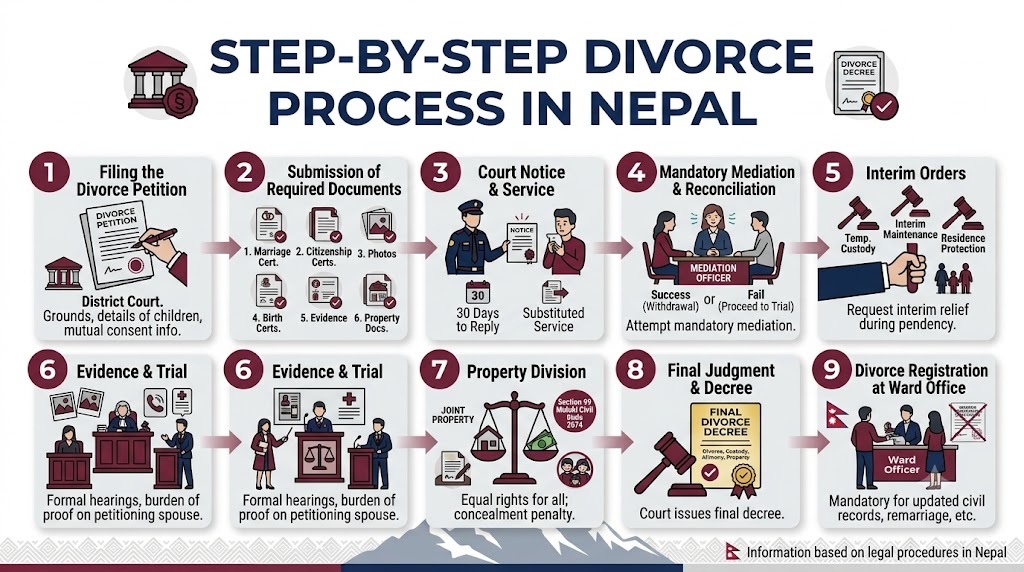
The divorce process in Nepal follows a structured judicial procedure. The steps vary depending on whether the divorce is mutual or contested.
Step 1: Filing the Divorce Petition
The process is initiated by filing a divorce petition in the District Court having jurisdiction over the place where either spouse resides. The petition must clearly state the grounds for divorce, the date and place of marriage, and details of any children. For mutual consent divorce Nepal, both spouses may file a joint petition or one may file with the other's written consent.
Step 2: Submission of Required Documents
The following documents must accompany the petition.
| Document | Purpose |
|---|---|
| Marriage registration certificate | Proof of valid marriage |
| Citizenship certificates of both spouses | Proof of identity and nationality |
| Passport-size photographs | Court records |
| Birth certificates of children (if any) | Custody and maintenance determinations |
| Evidence supporting grounds | Proof of adultery, cruelty, separation, etc. |
| Mutual consent agreement (if applicable) | Property and custody arrangements |
| Property ownership documents | Division of marital assets |
Step 3: Court Notice and Service on Respondent
After the petition is filed, the court issues a notice to the respondent spouse. The notice is served personally or through substituted service if the respondent cannot be located. The respondent is typically given 30 days to file a written reply.
Step 4: Mandatory Mediation and Reconciliation
Before proceeding to trial, the court is required to attempt mandatory mediation. A neutral mediator or judicial officer facilitates discussions between the spouses to explore reconciliation. If mediation succeeds, the petition may be withdrawn. If mediation fails, the court proceeds with the case. This step is required in both mutual consent divorce Nepal and contested divorce Nepal proceedings.
Step 5: Interim Orders
During the pendency of the case, either spouse may request interim orders from the court. The court may grant.
| Interim Relief | Purpose |
|---|---|
| Temporary child custody | Stability for minor children during litigation |
| Interim maintenance | Financial support for the dependent spouse |
| Residence protection | Prevention of expulsion from the marital home |
Step 6: Evidence and Trial
If the divorce remains contested, the court conducts formal hearings. Both parties present evidence, examine witnesses, and submit arguments. The burden of proof lies on the petitioning spouse to establish the statutory grounds. Evidence may include photographs, medical reports, witness testimony, communication records, and private investigator reports.
Step 7: Property Division
Under Section 99 of the Muluki Civil Code 2074, property division is mandatory before the divorce decree is finalized. Assets acquired during the marriage are treated as joint property. Both spouses and children have equal rights regardless of whose name appears on ownership documents. Both spouses are legally required to fully disclose all assets; concealment may result in the hidden property being awarded entirely to the other spouse.
Step 8: Final Judgment and Decree
After reviewing all evidence, the court issues a divorce decree if the grounds are proven or if mutual consent is confirmed. The decree addresses divorce, property division, child custody, alimony, and maintenance. The decree becomes final immediately, subject to appeal rights.
Step 9: Divorce Registration at Ward Office
After obtaining the court decree, both parties must register the divorce at the concerned Ward Office of the local municipality. The Ward Office cancels the marriage registration certificate and issues a divorce registration certificate. This step is mandatory for updating civil records, remarriage, passport updates, and property transfers.
Timeline and Cost for Divorce Process in Nepal
The divorce process in Nepal timeline and cost vary significantly depending on the type of divorce and complexity of disputes.
Estimated Timeline
| Divorce Type | Estimated Duration |
|---|---|
| Mutual consent divorce Nepal | 2 to 7 working days |
| Contested divorce Nepal (simple) | 6 months to 1 year |
| Contested divorce Nepal (complex) | 1 to 3 years or more |
Estimated Cost
| Expense Category | Estimated Cost (NPR) |
|---|---|
| Court filing fees | 500 to 2,000 |
| Legal fees (mutual consent) | 10,000 to 25,000 |
| Legal fees (contested) | 25,000 to 100,000+ |
| Property dispute fees | Additional charges apply |
| Documentation and notarization | 2,000 to 5,000 |
The total cost of divorce process in Nepal typically ranges from NPR 30,000 to NPR 100,000 for straightforward cases. Complex contested divorces involving substantial property or custody disputes may exceed NPR 200,000.
Property Division After Divorce in Nepal
Property division is one of the most consequential aspects of the divorce process in Nepal. Under Section 99 of the Civil Code, property acquired during the marriage is considered joint property of both spouses. The court is required to divide such property equitably before issuing the divorce decree.
Principles of Property Division
| Principle | Application |
|---|---|
| Equal rights | Both spouses have equal claim to marital assets |
| Full disclosure | Concealment of assets may result in forfeiture |
| Children's interests | Property division considers the welfare of children |
| Non-marital property | Assets acquired before marriage or through inheritance generally remain separate |
Importantly, if the wife remarries after divorce, her claim to the divided property may be affected, and the property may pass to legitimate heirs or coparceners under certain circumstances.
Alimony and Maintenance in Nepal
Under Section 100 of the Muluki Civil Code 2074, the court may order alimony or maintenance for the dependent spouse. The amount and duration are determined based on the financial capacity of the paying spouse, the needs of the recipient, and the standard of living maintained during the marriage.
| Alimony Type | Description |
|---|---|
| Lump sum payment | One-time settlement of maintenance obligation |
| Monthly or annual maintenance | Recurring payments for a specified period |
| Interim maintenance | Temporary support during pending litigation |
Either spouse may claim alimony based on financial dependency, subject to court discretion. However, if divorce is granted due to the wife's adultery, cruelty, or maintenance deprivation, her claim to alimony may be denied or reduced.
Child Custody After Divorce in Nepal
Child custody decisions in the divorce process in Nepal are guided by the best interest of the child standard.
| Child's Age | Custody Preference |
|---|---|
| Below 5 years | Custody generally awarded to the mother |
| Above 5 years | Custody may remain with the mother if she is unmarried |
| Above 10 years | The child's preference is considered by the court |
Visitation rights are typically granted to the non-custodial parent. Financial support for the child's upbringing is determined based on the parents' income and the child's needs. The court may modify custody arrangements if circumstances change significantly.
Automatic Divorce in Nepal
In addition to judicial divorce, the Muluki Civil Code 2074 recognizes certain circumstances where a marriage is automatically dissolved without requiring a court petition.
| Circumstance | Legal Effect |
|---|---|
| Marriage without free consent | Marriage is void by operation of law |
| Incestuous marriage (prohibited degrees) | Marriage is automatically dissolved |
| Wife remarries before obtaining divorce | Existing marriage is deemed terminated |
In these cases, no formal court petition is required. However, it is advisable to obtain a judicial declaration to ensure legal clarity for remarriage and property matters.
Common Mistakes to Avoid in Divorce Process Nepal
Many individuals weaken their legal position due to avoidable errors. The following mistakes should be carefully avoided.
First, failing to register the marriage initially may complicate divorce proceedings, although unregistered marriages may still be dissolved through affidavit evidence. Second, concealing assets during property disclosure may result in severe penalties, including forfeiture of the hidden property. Third, missing the 30-day response deadline after being served with a divorce notice may lead to an ex parte decree. Fourth, neglecting to obtain the divorce registration certificate from the Ward Office creates complications for remarriage and official record updates. Fifth, attempting to navigate contested divorce Nepal without legal representation often results in unfavorable property settlements or custody arrangements.
Why Professional Legal Assistance Is Essential for Divorce Process in Nepal
The divorce process in Nepal involves navigating complex statutory provisions, presenting evidence effectively, and protecting one's rights in property division and child custody matters. A poorly drafted petition or missed procedural deadline can delay the case by months or result in an unfavorable outcome. The emotional intensity of divorce often impairs judgment, making professional legal guidance indispensable.
Attorney Nepal Pvt. Ltd provides comprehensive legal support for individuals navigating the divorce process in Nepal. Our services include drafting and filing divorce petitions, representing clients in mediation and court proceedings, negotiating property settlements, securing child custody and alimony orders, and facilitating divorce registration at Ward Offices. With deep expertise in family law and the Muluki Civil Code 2074, we ensure that your rights are protected and the process is concluded as efficiently as possible.
References
For further reading and official verification, the following authoritative sources are recommended:
- Muluki Civil Code 2074 (2017) — Nepal Law Commission
- Muluki Civil Procedure Code 2074 — Nepal Law Commission
- National Penal Code 2074 — Nepal Law Commission
- Nepal Bar Association — Official Website
- Supreme Court of Nepal — Official Portal
- Ministry of Law, Justice and Parliamentary Affairs Nepal
- UN Women Nepal — Gender Equality and Women's Rights
- UNICEF Nepal — Child Protection
- World Bank — Women, Business and the Law — Nepal
- OHCHR Nepal — Human Rights
Frequently Asked Questions
Mutual consent divorce Nepal is typically completed within 2 to 7 working days. Contested divorce Nepal generally takes 6 months to 3 years, depending on complexity and court backlog.
Grounds include three years of separation, maintenance deprivation, cruelty, adultery, polygamy (for wives), and marital rape (for wives). Mutual consent divorce Nepal does not require proof of specific grounds.
Yes. Under Section 99 of the Civil Code, wives have equal rights to marital property acquired during the marriage. Property is divided equitably before the divorce decree is finalized.
Court fees range from NPR 500 to 2,000. Legal fees for mutual consent divorce range from NPR 10,000 to 25,000, while contested divorces may cost NPR 25,000 to 100,000 or more.
Yes. The court is required to attempt mandatory mediation before proceeding to trial in divorce cases. If mediation succeeds, the case may be settled without a contested judgment.
Children below 5 years generally remain with the mother. For children above 5 years, custody may remain with the mother if she is unmarried. Children above 10 years may express their preference, which the court considers.
Full online divorce is not legally available in Nepal. However, an authorized representative or lawyer may initiate and conclude proceedings on behalf of a party who is abroad or unable to attend court personally.
Required documents include the marriage certificate, citizenship certificates, photographs, children's birth certificates (if applicable), evidence supporting grounds, and property documents.
If one spouse does not consent, the other may file for contested divorce Nepal by proving statutory grounds. The court may grant divorce even without the respondent's consent if the grounds are established.
Alimony is not automatic. It is awarded based on financial dependency, the paying spouse's capacity, and the standard of living during marriage. Either spouse may claim alimony under Section 100 of the Civil Code.
This article is for general informational purposes only and does not constitute legal advice. For advice on your specific situation, please contact Attorney Nepal directly.