
Table of Contents
The decision to start a business in Nepal as a foreigner is governed by a structured legal framework that involves multiple regulatory approvals. When an individual or entity from outside Nepal intends to establish a commercial presence, the process is not completed merely by standard company incorporation. Instead, prior approval from the Department of Industry or the Investment Board of Nepal is required. Consequently, the procedure is regarded as more complex than domestic company registration.
Furthermore, the foreign company registration process in Nepal is primarily regulated by the Foreign Investment and Technology Transfer Act, 2075 (2019), commonly referred to as FITTA. This legislation replaced the earlier Foreign Investment and Transfer of Technology Act, 2049 (1992). Under FITTA, foreign investment is permitted only in industrial activities, and specific minimum investment thresholds must be met.
In this guide, the entire procedure is explained in a step-by-step manner. Moreover, the documents required, the regulatory framework, sectoral restrictions, and post-registration obligations are outlined in detail.
What Is Required to Start a Business in Nepal as a Foreigner?
A foreigner is defined as any individual, company, or entity that is not a citizen of Nepal or incorporated under Nepali law. When such a person intends to start a business in Nepal as a foreigner, the investment is classified as Foreign Direct Investment (FDI). This classification triggers additional regulatory requirements that are not applicable to domestic investors.
Additionally, the FDI approval process in Nepal mandates that foreign investors commit a minimum investment amount. The current threshold is set at NPR 20 million, which is approximately USD 150,000. However, an exception is made for companies operating in the information technology sector, where no minimum investment threshold is applied.
Notably, the foreign investment regime in Nepal operates through an approval-based mechanism. Consequently, foreign investors are required to obtain approval from either the Department of Industries (DOI) for investments up to NPR 6 billion, or the Investment Board of Nepal (IBN) for investments exceeding this amount.
Why Foreigners Choose to Start a Business in Nepal
Nepal is increasingly being recognized as an emerging destination for foreign investment. The country is endowed with abundant natural resources, particularly in the hydropower, tourism, and agricultural sectors. Furthermore, political stability following the promulgation of the 2015 Constitution has created a more predictable regulatory environment.
Moreover, the government's commitment to attracting foreign investment is reflected in the establishment of the One Stop Service Centre (OSSC). This facility is designed to streamline the approval process by bringing together representatives from the Department of Industry, Office of the Company Registrar, Inland Revenue Office, and Nepal Rastra Bank under a single roof.
In addition, the foreign business setup in Nepal is supported by bilateral investment treaties and trade agreements. These instruments provide protections against expropriation and guarantee the right to repatriate profits and capital.
Legal Framework for Foreign Business Registration in Nepal
The process to start a business in Nepal as a foreigner is governed by the following laws and regulations:
| Legal Instrument | Relevance to Foreign Business Registration |
|---|---|
| Foreign Investment and Technology Transfer Act, 2075 (2019) | Primary legislation governing FDI approval, minimum investment, and sectoral restrictions |
| Companies Act, 2063 (2006) | Governs company incorporation at the Office of the Company Registrar |
| Industrial Enterprises Act, 2076 (2019) | Provides tax incentives and operational guidelines for industrial enterprises |
| Income Tax Act, 2058 (2002) | Regulates tax obligations, withholding taxes, and repatriation of profits |
| Nepal Rastra Bank Act, 2058 (2002) | Empowers NRB to regulate foreign exchange and capital inflow |
| Labour Act, 2074 (2017) | Governs employment contracts, social security, and labour compliance |
| Anti-Money Laundering Act, 2064 (2008) | Mandates AML and KYC compliance for all businesses |
| Foreign Investment and Foreign Loan Management Bylaws, 2021 | Introduces automatic route elements and streamlines NRB procedures |
Moreover, sector-specific laws may apply depending on the nature of the business. For instance, banking and financial institutions require approval from Nepal Rastra Bank, while telecommunications investments require clearance from the Nepal Telecommunications Authority.
Eligibility and Restrictions for Foreign Investors
Before the decision to start a business in Nepal as a foreigner is finalized, the eligibility of the proposed business activity must be verified. Nepal maintains a positive list approach, meaning foreign investment is permitted only in sectors that are explicitly opened.
Sectors Where Foreign Investment Is Permitted
Foreign investment is generally permitted in the following sectors:
| Sector | Approval Authority | Additional Requirements |
|---|---|---|
| Manufacturing and Industry | DOI / IBN | Industry registration required |
| Hydropower and Energy | DOI / IBN | DoED license and PPA with NEA |
| Tourism and Hospitality | DOI / IBN | Department of Tourism approval |
| Information Technology | DOI / IBN | No minimum investment threshold |
| Agriculture and Forestry | DOI / IBN | Sectoral guidelines apply |
| Construction and Infrastructure | DOI / IBN | Large projects require IBN approval |
| Health and Education | DOI / IBN | Ministry of Health / Education approval |
Sectors Restricted for Foreign Investment
Certain sectors are reserved for Nepali citizens or are subject to ownership caps. These include:
- Retail and wholesale trading (trading activities are generally restricted)
- Personal services and small-scale enterprises
- Certain agricultural activities involving primary production
- Arms and ammunition manufacturing
- Real estate speculation and property trading
Furthermore, it is strongly advised that a sectoral feasibility study be conducted before the FDI application is submitted. This ensures that the proposed business falls within the permitted categories.
Step-by-Step Process to Start a Business in Nepal as a Foreigner
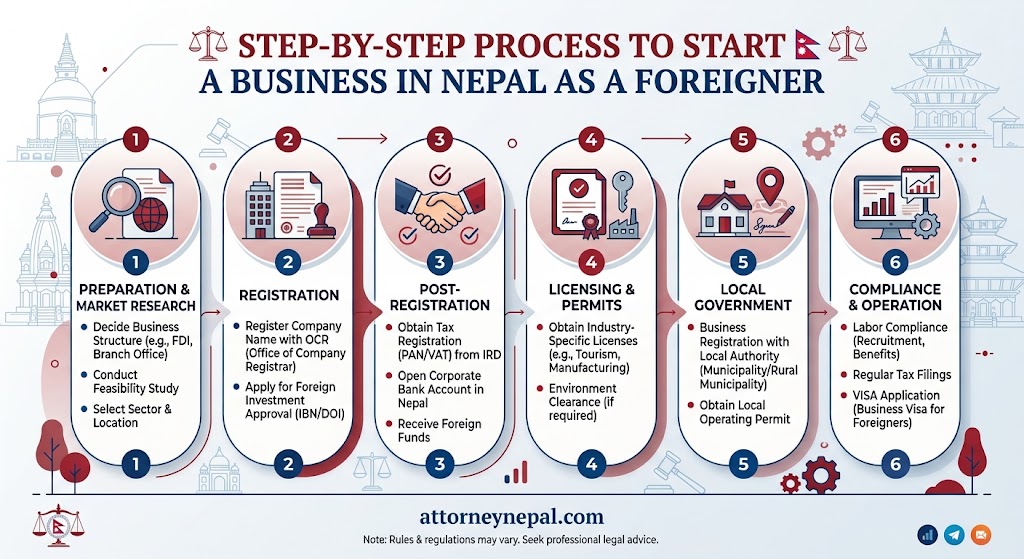
The following steps are required to be followed in sequential order to establish a legally compliant foreign-owned business.
Step 1: Conduct Sectoral Feasibility and Verify Eligibility
Before any application is filed, the proposed business activity must be verified against the positive and negative investment lists. A detailed feasibility study is required to be prepared. This study must outline the nature of the business, projected investment amount, employment generation, and financial projections.
Moreover, the minimum investment commitment must be confirmed. For most sectors, this is NPR 20 million (approximately USD 150,000). For IT companies, this minimum threshold is not applicable.
Step 2: Obtain Foreign Investment Approval from DOI or IBN
The FDI approval in Nepal is the cornerstone of the foreign business establishment process. The application is required to be submitted to the FITT Unit of the One Stop Service Centre (OSSC) through the online portal at imis.doind.gov.np.
For investments up to NPR 6 billion, the Department of Industry is the approving authority. For investments exceeding this amount, the Investment Board of Nepal must be approached.
The statutory timeline for approval is 15 working days from the date of complete application submission. However, in practice, the process may take 30 to 45 days depending on documentation completeness and application complexity.
Step 3: Prepare and Submit FDI Application Documents
The following documents are required to be submitted with the FDI application:
| Document | Purpose |
|---|---|
| Detailed Project Proposal | Outlines business nature, investment amount, and financial projections |
| Joint Venture Agreement (if applicable) | Governs the relationship between foreign and local partners |
| Notarized Passport Copies | Identity verification of individual foreign investors |
| Certificate of Incorporation | Proof of legal existence for corporate foreign investors |
| Memorandum and Articles of Association | Charter documents of the foreign parent company |
| Shareholder Details | Names, addresses, and shareholding percentages of direct and indirect owners |
| Board Resolution | Authorizes the investment in Nepal |
| Financial Credibility Certificate | Issued by the investor's bank, confirming sufficient funds |
| Latest Audit Reports | Required for investments above USD 100 million |
| Power of Attorney | Required if the investor cannot appear in person |
Furthermore, all foreign documents are required to be notarized and, where necessary, translated into English.
Step 4: Register the Company at the Office of the Company Registrar
Once FDI approval is granted, company registration is required to be completed at the OCR unit of the OSSC. The company is required to be incorporated within three working days of receiving the approval letter.
The registration is conducted through the CAMIS portal at camis.ocr.gov.np. The following steps are involved:
- Reservation of the company name in both English and Nepali
- Preparation of the Memorandum of Association and Articles of Association
- Upload of required documents, including promoters' identification
- Submission of the application for OCR examination
- Payment of the government registration fee
- Issuance of the company registration certificate
Moreover, the authorized capital entered in CAMIS must correspond with the figures stated in the MOA and AOA. Inconsistencies between these documents are known to cause delays.
Step 5: Obtain Tax Registration (PAN/VAT)
After the company registration certificate is issued, tax registration is required to be completed at the Inland Revenue Office unit of the OSSC. The Permanent Account Number (PAN) and Value Added Tax (VAT) registration are typically completed within one to two working days.
The following documents are required for tax registration:
- Company registration certificate
- Memorandum and Articles of Association
- Board resolution appointing authorized signatories
- Lease agreement or ownership proof of the registered office
- Identification documents of directors
Step 6: Register the Industry at the Department of Industry
Industry registration is required to be completed within seven working days of company incorporation. This registration classifies the business under the appropriate industrial categories and is necessary for availing tax benefits and incentives under the Industrial Enterprises Act.
The industry registration certificate is issued by the Department of Industry and must be displayed at the business premises.
Step 7: Obtain NRB Approval for Capital Inflow
Before foreign currency is remitted into Nepal, approval from the Nepal Rastra Bank unit at the OSSC is required. This approval ensures compliance with foreign exchange controls and remittance procedures.
Subsequently, a corporate bank account is required to be opened with a licensed Nepalese commercial bank. The bank will require the company registration certificate, tax registration certificate, board resolution, and identification documents of authorized signatories.
Step 8: Remit Investment and Obtain Foreign Investment Certificate
The committed investment amount is required to be transferred from abroad to the company's Nepalese bank account through formal banking channels. The bank will issue a Foreign Investment Certificate confirming receipt of the foreign currency.
It is important to note that the investment must be brought in within the timeline specified in the FDI approval letter. Failure to do so may result in the lapse of the approval.
Step 9: Record the Investment with Nepal Rastra Bank
Within six months of receiving the investment, an application for recording the foreign investment is required to be submitted to NRB. The recording application must be accompanied by:
- FDI approval letter
- Company registration certificate
- Industry registration certificate
- Tax registration certificate
- Foreign Investment Certificate from the bank
- Audited financial statements
Upon verification, NRB will issue a foreign investment recording certificate. This document is essential for future repatriation of investment and returns.
Step 10: Complete Sector-Specific Approvals (If Applicable)
Depending on the nature of the business, additional approvals may be required:
| Sector | Regulatory Body | Approval Required |
|---|---|---|
| Banking and Financial Institutions | Nepal Rastra Bank | Preliminary and final licensing |
| Telecommunications | Nepal Telecommunications Authority | Technical and financial evaluation |
| Hydropower | Department of Electricity Development | Survey license and generation license |
| Tourism | Department of Tourism | Hotel classification and operational license |
| Healthcare | Ministry of Health and Population | Health facility standards compliance |
| Education | Ministry of Education | Curriculum and affiliation approval |
Furthermore, an environmental impact assessment may be required for certain industrial projects. This process typically takes 45 to 60 days.
Timeline and Costs for Foreign Business Registration
The process to start a business in Nepal as a foreigner is generally completed within the following timeframe:
| Phase | Estimated Duration |
|---|---|
| Document Preparation and Feasibility Study | 7–14 days |
| FDI Approval (DOI/IBN) | 15–45 days |
| Company Registration (OCR) | 3–5 days |
| NRB Approval for Capital Inflow | 2–3 days |
| PAN/VAT Registration | 1–2 days |
| Industry Registration | 5–7 days |
| Bank Account Opening | 2–3 days |
| Capital Remittance and NRB Recording | 5–10 days |
| Sector-Specific Approvals | 15–60 days (if applicable) |
Total Estimated Time: 1.5 to 3 months
The costs associated with the process are outlined below:
| Cost Component | Approximate Amount |
|---|---|
| Company Registration Fee | Starts from NPR 9,500 |
| Industry Registration Fee | NPR 20,000 |
| Business Visa | USD 35 per month |
| Professional Legal Fees | USD 3,000 – 15,000 |
| Accounting and Audit Services | USD 1,000 – 5,000 annually |
| Business Consulting / Feasibility Study | USD 2,000 – 10,000 |
Moreover, additional costs may be incurred for notarization, translation, and sector-specific licensing.
Types of Foreign Investment Permitted in Nepal
When a foreigner decides to start a business in Nepal as a foreigner, the investment may take several forms:
| Investment Type | Description | Key Features |
|---|---|---|
| Equity Investment | Formation of new company or share subscription | Most common form; allows full ownership in most sectors |
| Technology Transfer | Licensing of patents, trademarks, and technical know-how | Royalty payments subject to caps; repatriable after tax |
| Foreign Loan | Loan financing to Nepalese companies | Subject to debt-equity ratios and interest rate limits |
| Asset Purchase | Acquisition of assets of existing companies | Useful for acquiring operational businesses |
| Lease Financing | Lease of equipment, machinery, or aircraft | Common in aviation and heavy equipment sectors |
| Branch Operations | Establishment of a branch of a foreign company | Limited to specific sectors; full liability of parent company |
Furthermore, equity investment is regarded as the most flexible form of FDI. It enables foreign investors to participate in company management and exercise voting rights.
Post-Registration Compliance Obligations
After the business is established, several ongoing compliance obligations are required to be fulfilled:
- Annual financial statements must be prepared in accordance with Nepal Financial Reporting Standards
- Tax returns must be filed with the Inland Revenue Department on a quarterly and annual basis
- Social Security Fund (SSF) registration is mandatory for all formal sector employees
- Monthly SSF contributions are required: 11% from the employer and 31% from the employee's salary
- Annual returns must be filed with the Office of the Company Registrar
- Foreign investment records must be updated with NRB periodically
- Board meetings must be held and minutes recorded in the statutory register
- Share certificates must be issued to shareholders within three months of registration
Moreover, companies that fail to comply with these obligations may face penalties, fines, or regulatory sanctions.
Repatriation of Profits and Capital
One of the primary concerns for foreign investors is the ability to repatriate profits and capital. Under FITTA, foreign investors are permitted to repatriate dividends after one year of investment. There is no lock-in period for dividend repatriation once the initial one-year period has expired.
Furthermore, the repatriation of investment capital is permitted upon liquidation or sale of shares, subject to approval from the Department of Industry and NRB. The repatriation process requires:
- Proof of tax clearance from the Inland Revenue Department
- NRB foreign investment recording certificate
- DOI/IBN approval for capital repatriation
- Bank documentation confirming the source of funds
Consequently, proper documentation from the outset is regarded as essential for smooth repatriation.
Common Mistakes to Avoid When Starting a Business in Nepal
Several errors are frequently observed when foreigners attempt to start a business in Nepal as a foreigner. These mistakes are required to be avoided:
- Failing to verify sectoral eligibility before submitting the FDI application
- Underestimating the documentation requirements for DOI/IBN approval
- Inconsistencies between CAMIS data and the MOA/AOA
- Delaying tax registration beyond the prescribed timeline
- Neglecting to obtain NRB approval before remitting capital
- Overlooking the requirement for a local registered office address
- Inadequate preparation of the feasibility study and financial projections
- Failure to register with the Social Security Fund after hiring employees
- Ignoring sector-specific licensing requirements
- Poor maintenance of statutory registers and board minutes
Moreover, it is strongly advised that professional legal and accounting consultants be engaged from the outset. Self-navigation of the regulatory framework is known to result in costly delays and compliance failures.
Frequently Asked Questions (FAQs)
Can a foreigner fully own a company in Nepal?
Yes. A foreigner is permitted to start a business in Nepal as a foreigner with 100% ownership in most industrial sectors. However, certain sectors such as retail trading and personal services are reserved for Nepali citizens. Sectoral verification is required before application.
What is the minimum investment required for foreign business in Nepal?
The minimum investment required is NPR 20 million, approximately USD 150,000. However, companies operating in the information technology sector are exempt from this minimum threshold.
How long does it take to register a foreign company in Nepal?
The complete process, from FDI approval to operational readiness, typically requires 1.5 to 3 months. The statutory timeline for FDI approval is 15 working days, but practical timelines may extend to 30–45 days.
Is a local partner required to start a business in Nepal as a foreigner?
No. A local partner is not mandatory for most sectors. Foreign investors are permitted to establish wholly foreign-owned companies. However, joint ventures with local partners are often recommended for businesses that require local market knowledge.
What documents are needed for FDI approval in Nepal?
The application must include a detailed project proposal, notarized passport copies, certificate of incorporation, MOA and AOA of the parent company, shareholder details, board resolution, financial credibility certificate, and power of attorney if applicable.
Can foreign investment profits be repatriated from Nepal?
Yes. Dividends may be repatriated after one year of investment. Capital may be repatriated upon liquidation or share sale, subject to approval from DOI/IBN and NRB.
What is the role of the One Stop Service Centre (OSSC)?
The OSSC brings together representatives from DOI, OCR, IRO, and NRB under a single facility. It is designed to streamline the approval process and reduce the time required for foreign business registration.
Is a business visa required for foreign investors?
Yes. Foreign investors and their representatives are required to obtain a business visa. The fee is approximately USD 35 per month. The visa application requires the FDI approval letter and company registration documents.
What is the difference between DOI and IBN approval?
The Department of Industry approves investments up to NPR 6 billion. The Investment Board of Nepal approves investments exceeding this threshold. Both authorities operate under the FITTA framework.
Are trading businesses permitted for foreign investors in Nepal?
Generally, no. Foreign investment in retail and wholesale trading activities is restricted. Foreign investors are encouraged to focus on industrial, manufacturing, and service-oriented activities.
Why Choose Attorney Nepal . Pvt Ltd for Foreign Business Registration?
At Attorney Nepal . Pvt Ltd, the process to start a business in Nepal as a foreigner is managed with comprehensive legal expertise and regulatory insight. Our team possesses extensive experience in foreign direct investment law, corporate governance, and cross-border transaction structuring.
Moreover, our services include:
- Sectoral feasibility analysis and eligibility verification
- Preparation of project proposals and FDI application documents
- Coordination with DOI, IBN, OCR, and NRB
- Drafting of Memorandum and Articles of Association
- Tax registration and compliance advisory
- SSF registration and labour law compliance
- Ongoing corporate secretarial services
Call to Action: If you are planning to start a business in Nepal as a foreigner, contact Attorney Nepal . Pvt Ltd today. Our experienced legal professionals will guide you through every regulatory requirement with precision and diligence. Schedule your confidential consultation now.
Disclaimer
The information provided in this guide is intended for general informational and educational purposes only. It does not constitute legal advice, nor does it create an attorney-client relationship. The laws and regulations referenced herein are subject to amendment, and individual circumstances may vary. Readers are strongly advised to consult with a qualified legal professional before undertaking any foreign investment or business registration. Attorney Nepal . Pvt Ltd disclaims all liability for any actions taken based on the contents of this publication.
References
For further reading and verification of the legal framework discussed in this guide, the following authoritative sources are referenced:
- Office of the Company Registrar, Nepal – Official government portal for company registration and administration in Nepal.
- Department of Industry, Nepal – Primary authority for foreign investment approval and industry registration.
- Investment Board of Nepal – Government body approving large-scale investments exceeding NPR 6 billion.
- Nepal Rastra Bank – Central bank of Nepal regulating foreign exchange, capital inflow, and financial sector compliance.
- Inland Revenue Department, Nepal – Official source for tax registration, PAN, VAT, and corporate tax compliance.
- One Stop Service Centre (OSSC) – Integrated service facility streamlining foreign business registration.
- Ministry of Industry, Commerce and Supplies – Government ministry overseeing industrial policy and foreign investment frameworks.
- Nepal Telecommunications Authority – Regulatory body for telecommunications sector approvals.
- Department of Electricity Development – Authority issuing licenses for hydropower and energy projects.
- World Bank Doing Business Report – Nepal – International benchmark for business regulations and investment climate.
- International Finance Corporation (IFC) Nepal – Global authority on private sector development and foreign investment standards.
- Asian Development Bank – Nepal – Regional development bank providing insights on Nepal's economic and regulatory environment.
- UNCITRAL Legislative Guide on Foreign Investment – International reference for foreign investment law and dispute resolution best practices.
End of Guide
This content has been prepared by Attorney Nepal . Pvt Ltd and is protected under applicable copyright laws. Unauthorized reproduction is prohibited.
This article is for general informational purposes only and does not constitute legal advice. For advice on your specific situation, please contact Attorney Nepal directly.