
Updated on: March 7, 2026
Notary in Nepal services are essential for document authentication, legal verification, and international recognition. Governed by the Notary Public Act 2063 (2007) and Notary Public Rules 2064, the Nepalese notarial system ensures document integrity through qualified legal professionals. Whether you require notary attestation Nepal for property transactions, power of attorney notarization, or apostille services for international use, understanding the legal framework is critical. Over 200,000 documents are notarized annually in Nepal, with increasing demand for online notary services following digital transformation initiatives.
The notary legal framework Nepal is established through:
| Legal Instrument | Enactment Year | Key Provisions |
|---|---|---|
| Notary Public Act 2063 | 2007 | Defines notary appointment, qualifications, powers, and prohibited acts |
| Notary Public Rules 2064 | 2008 | Procedures for certification, translation, verification, and fee structures |
| Nepal Notary Public Council Regulations | 2018 | Council composition, examination standards, disciplinary procedures |
| National Civil Code 2074 | 2017 | General authentication and evidentiary value of notarized documents |
According to Section 2(a) of the Notary Public Act, a notary public is defined as "a person appointed or recognized as a Notary Public pursuant to this Act." The Nepal Notary Public Council, chaired by the Attorney General, oversees all notarial functions including certification distribution, examination conduct, and compliance monitoring.
Notary qualification Nepal requirements are stringent to ensure professional competence:
| Requirement | Specification | Verification Authority |
|---|---|---|
| Citizenship | Nepali citizen | Citizenship certificate |
| Education | Bachelor's degree in law (LL.B) | University transcripts |
| Experience | Minimum 7 years continuous legal practice | Nepal Bar Association records |
| Examination | Pass Notary Public Council examination | Council certification |
| Character | Good moral character, no criminal record | Police clearance |
Section 11 of the Notary Public Act prohibits appointment of individuals who:
The notary appointment Nepal process involves:
Notary public Nepal officials exercise these statutory functions:
| Function Category | Specific Powers | Legal Basis |
|---|---|---|
| Document Certification | Authenticate original documents, certify true copies | Section 27, Notary Public Act |
| Signature Verification | Witness and verify signatures on legal instruments | Section 28 |
| Affidavit Administration | Administer oaths and affirmations for sworn statements | Section 29 |
| Translation Certification | Certify accuracy of translated documents | Section 28 |
| Power of Attorney | Notarize POA documents for domestic and international use | General notarial authority |
| Property Document Verification | Verify ownership status, check for encumbrances | Section 27(7) |
Notaries are strictly prohibited from:
The notarization process Nepal follows standardized procedures:
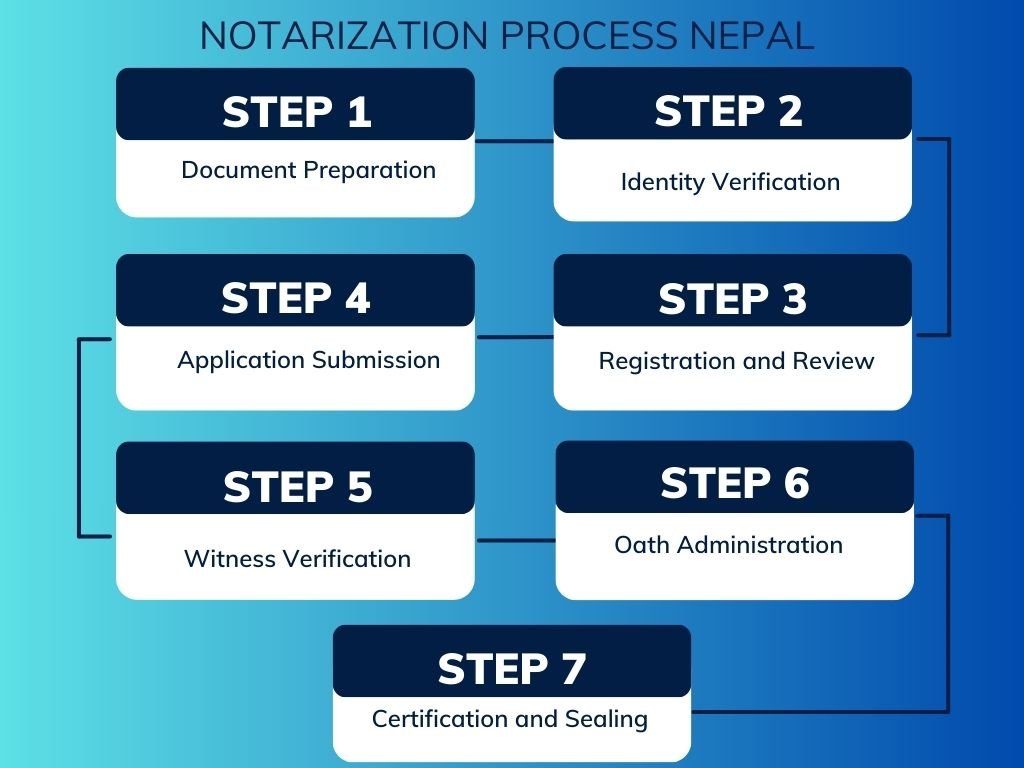
Ensure documents are complete with no blank spaces (cross out if necessary). For certified copies, bring original documents for comparison.
Present valid government-issued photo identification:
Submit formal application to notary public with:
Notary registers application in official document certification register, reviews document completeness, and verifies authenticity.
Two witnesses must verify the document and sign either the document itself or a separate memo. Witnesses confirm applicant's identity and voluntary execution.
For affidavits and court submissions, notary administers formal oath or affirmation ensuring applicant understands document contents and legal consequences.
Notary signs document with official seal, includes certification statement, and records registration number from official register.
For property documents, additional verification confirms ownership status and ensures property is not leased or frozen.
Processing Time: Standard notarization completes within 15-30 minutes; complex property or international documents may require 1-2 business days.
Notary documents Nepal categories include:
| Document Category | Specific Examples | Notarization Purpose |
|---|---|---|
| Property Documents | Sale deeds, transfer agreements, mortgage documents, lease agreements | Verify ownership, prevent fraud, ensure enforceability |
| Business Documents | MOA/AOA, contracts, board resolutions, shareholder agreements | Corporate compliance, international recognition |
| Legal Instruments | Affidavits, sworn statements, declarations | Court admissibility, evidentiary value |
| Power of Attorney | General POA, special POA, property POA | Authority verification, prevent misuse |
| Educational Certificates | Degrees, transcripts, diplomas | International study, employment verification |
| Personal Documents | Birth certificates, marriage certificates, death certificates | Immigration, visa applications, legal proceedings |
| Financial Documents | Bank statements, loan agreements, insurance claims | Banking compliance, dispute resolution |
| Immigration Documents | Visa applications, passport copies, travel authorizations | Embassy requirements, border clearance |
For company registration notarization Nepal, the following require notary attestation:
Notary fees Nepal are regulated by the Notary Public Council with standardized rates:
| Service Type | Fee Range (NPR) | Notes |
|---|---|---|
| Simple affidavits/declarations | 100 - 300 | Standard sworn statements |
| Signature verification | 100 - 500 | Per signature, contracts and agreements |
| Certified true copies | 50 - 200 per page | Academic certificates, passports, citizenship cards |
| Power of Attorney | 300 - 1,000 | Domestic or foreign use, complexity dependent |
| Property documents (up to NPR 10 lakhs value) | 500 - 1,000 | Sale deeds, transfer documents |
| Property documents (above NPR 10 lakhs value) | 1,000 - 5,000 | Higher value transactions |
| Business agreements | 1,000 - 10,000 | Corporate contracts, MOUs |
| Translation certification | 200 - 500 per page | Excludes translation cost |
| International documents | 1,000 - 5,000 | Apostille preparation, embassy attestation |
Notary verification Nepal ensures evidentiary value:
Notarized documents are admissible as evidence in Nepalese courts under the National Civil Code 2074. The notary's official seal creates a presumption of authenticity regarding:
The Nepal Notary Public Council maintains:
Parties may challenge notarized documents through:
Notary for foreign documents Nepal involves additional authentication layers:
| Destination Country | Authentication Process | Authority |
|---|---|---|
| Hague Convention countries | Notarization → Ministry of Foreign Affairs Apostille | MoFA Nepal |
| Non-Hague Convention countries | Notarization → MoFA attestation → Embassy legalization | Respective embassies |
Important Note: While some sources claim Nepal joined the Hague Convention in 2011, authoritative diplomatic sources indicate Nepal has not acceded to the Hague Apostille Convention, requiring traditional legalization for all countries.
Documents from foreign jurisdictions require:
Digital notarization Nepal is evolving:
The Nepal Notary Public Council plans:
Notary vs gazetted officer attestation Nepal distinction:
| Aspect | Notary Public | Gazetted Officer |
|---|---|---|
| Authority Source | Notary Public Act 2063 | Government Service Act |
| Primary Function | Document authentication, witnessing | Administrative attestation |
| Legal Specialization | Legal document focus | General administrative verification |
| International Recognition | Higher for legal documents | Limited to domestic government use |
| Court Admissibility | Strong presumption of authenticity | Varies by document type |
For most legal and international documents, notary attestation is preferred due to specialized legal training and broader international recognition.
What is a notary in Nepal?
A notary in Nepal is a legally authorized professional who authenticates documents, verifies signatures, administers oaths, and certifies translations under the Notary Public Act 2063. Notaries prevent fraud and ensure document legality for court, government, and international use.
How to become a notary in Nepal?
To become a notary in Nepal, you must: (1) be a Nepali citizen with LL.B degree, (2) have 7+ years continuous legal practice, (3) pass the Notary Public Council examination, (4) complete mandatory training, and (5) receive official certification. Good moral character and no criminal record are essential.
What documents need notarization in Nepal?
Common notary documents Nepal includes: property deeds, power of attorney, affidavits, business contracts, educational certificates for international use, marriage/birth certificates, company registration documents, and immigration papers. Requirements vary by intended use and destination country.
How much does notary cost in Nepal?
Notary fees Nepal range from NPR 50-200 for simple copy certification to NPR 5,000+ for complex international business documents. Standard affidavits cost NPR 100-300, power of attorney NPR 300-1,000, and property documents vary by value (NPR 500-5,000).
Is online notarization legal in Nepal?
Online notarization Nepal services are offered by private providers and recognized for certain documents, though the Notary Public Act traditionally requires physical presence. Electronic signatures are legally valid, but remote notarization for property and court documents remains limited.
What is the difference between notarization and attestation?
Notarization is performed by licensed notaries with legal training, providing enhanced authentication for legal documents. Attestation is general verification by authorized officers (including gazetted officers) without specialized legal notarial functions. Notarization carries higher evidentiary weight and international recognition.
How long does notarization take in Nepal?
Standard notarization process Nepal completes in 15-30 minutes for simple documents. Complex property verification or international apostille preparation may require 1-2 business days. Online services offer faster turnaround for eligible documents.
Can foreigners use notary services in Nepal?
Yes, foreigners can access notary services Nepal with valid passport and additional documentation. Foreign documents require embassy certification before Nepalese notarization. The U.S. Embassy and other diplomatic missions provide notarial services for their citizens at prescribed fees (e.g., $50 per signature for U.S. Embassy services).
What is apostille and does Nepal issue apostilles?
An apostille is international document authentication under the Hague Convention. While some sources claim Nepal joined in 2011, authoritative diplomatic sources indicate Nepal has not acceded, requiring traditional multi-step legalization for international document use.
How do I verify a notarized document in Nepal?
Verify notary verification Nepal through: (1) physical examination of official notary seal and signature, (2) registration number cross-check with notary's official register, (3) Nepal Notary Public Council digital verification systems where available, and (4) direct inquiry to the notary's office for authentication confirmation.
Notary in Nepal services are fundamental to legal document authentication, property transaction security, and international document recognition. The Notary Public Act 2063 establishes rigorous qualification standards ensuring notaries possess the legal expertise necessary for proper document verification. With fees ranging from NPR 50 for simple certifications to NPR 5,000+ for complex international business documents, the notarial system provides accessible legal authentication across economic sectors.
As Nepal continues digital transformation, online notary services are expanding while maintaining traditional standards for high-stakes property and court documents. Whether you require notary attestation Nepal for company registration, power of attorney notarization, or international apostille preparation, professional notarial services ensure your documents meet all legal requirements.
For expert notary services Nepal including document authentication, translation certification, and international legalization, Attorney Nepal PVT LTD provides comprehensive support. Our team ensures your notarization requirements are handled with precision, legal compliance, and efficiency.
Disclaimer: This article is prepared for informational purposes only and does not constitute legal advice. Laws and regulations are subject to amendment. Readers should consult qualified legal professionals for document-specific guidance. Attorney Nepal PVT LTD assumes no liability for actions taken based on this content.
References
 March 08, 2026 - BY Admin