
A manpower license in Nepal is the mandatory legal authorization issued by the Department of Foreign Employment (DoFE) under the Ministry of Labour, Employment and Social Security, permitting a company to recruit Nepali citizens for foreign employment opportunities. This license represents the cornerstone of legal operation for recruitment agencies and establishes the regulatory framework governing Nepal's foreign employment industry, which contributes significantly to the national economy through remittance inflows.
Manpower licensing in Nepal constitutes a specialized regulatory mechanism designed to systematize and monitor the recruitment of Nepali citizens for foreign employment. The legal framework establishes stringent controls to protect migrant workers from exploitation while enabling legitimate businesses to operate within defined parameters. Nepal's foreign employment sector, regulated through this licensing system, channels millions of workers annually to destinations across the Middle East, Southeast Asia, and beyond.
The Department of Foreign Employment (DoFE) functions as the sole statutory authority empowered to grant, renew, suspend, and revoke manpower licenses. This centralized control ensures uniform application of legal standards and facilitates direct oversight of recruitment practices. The regulatory architecture balances economic opportunities for citizens with robust protection mechanisms, reflecting Nepal's constitutional commitment to safe and dignified foreign employment.
The Foreign Employment Act, 2064 (2007) serves as the principal legislative instrument governing manpower licensing in Nepal. Section 11 of the Act explicitly prohibits any entity from operating foreign employment business without obtaining a valid license from DoFE. Section 12 delineates the specific conditions and procedures for license issuance, establishing the foundational legal requirements.
The Foreign Employment Rules, 2064 (2008) provide granular operational details, with Rule 4 specifying application procedures, Rule 5 detailing documentation requirements, and Rule 6 outlining the inspection and verification process. These rules operate in conjunction with the Labour Act, 2074 (2017) and the Company Act, 2063 (2006), which govern corporate establishment and general labour relations.
Section 35 of the Foreign Employment Act establishes penalties for unlicensed operations, prescribing imprisonment up to three years or fines up to NPR 500,000, or both, for violations. Section 38 authorizes DoFE to suspend or cancel licenses for breaches of statutory obligations, creating a stringent compliance environment.
The Department of Foreign Employment (DoFE) operates as the primary licensing authority under the administrative supervision of the Ministry of Labour, Employment and Social Security. DoFE's mandate encompasses license issuance, renewal, amendment, monitoring, and enforcement actions against violations.
The Ministry of Labour, Employment and Social Security provides policy direction and approves regulatory amendments affecting the licensing framework. The ministry also handles appeals against DoFE decisions under the Administrative Procedure Act, 2076 (2019).
Supporting institutions include:
Eligibility for manpower license acquisition requires compliance with corporate structure, financial capacity, and promoter integrity standards. The following conditions must be satisfied:
Company Structure:
Promoter Requirements:
Office and Infrastructure:
Personnel Requirements:
The application dossier must contain comprehensive documentation organized into distinct categories:
Company Documents:
Tax and Financial Documents:
Office Premises Documents:
Promoter and Personnel Documents:
Compliance Documents:
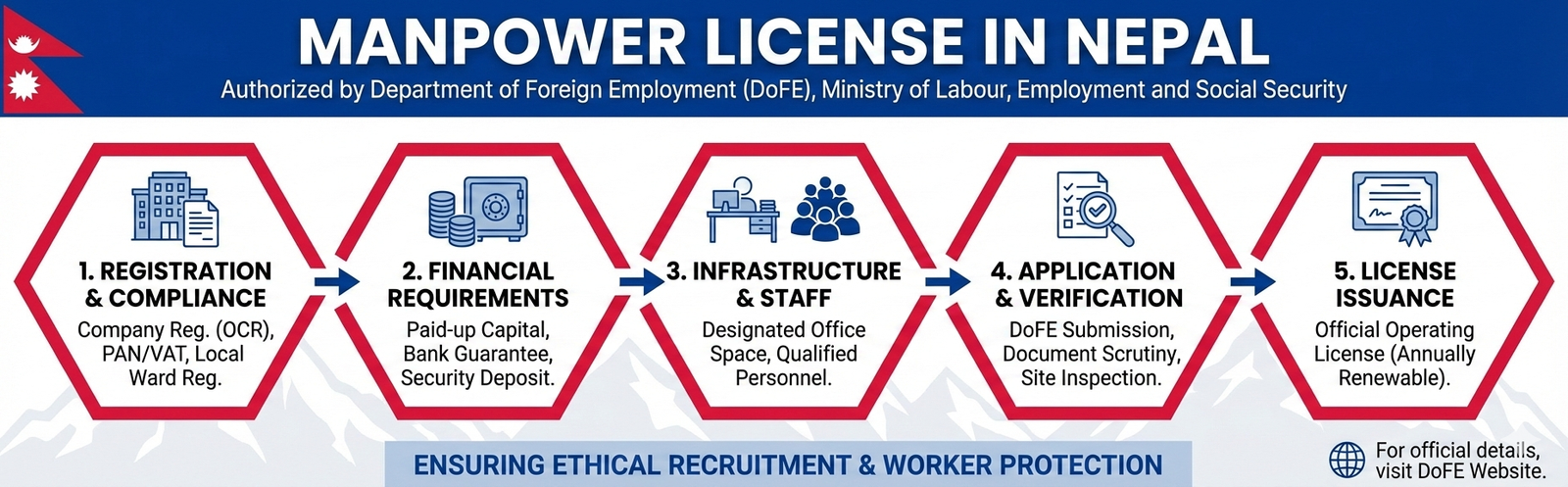
The application process follows a sequential procedure requiring meticulous documentation and statutory compliance:
Step 1: Company Incorporation
Incorporate a private limited company at the Office of Company Registrar with explicit foreign employment business objective. Deposit minimum paid-up capital of NPR 5,000,000 into the company's bank account and obtain verification from a licensed auditor.
Step 2: Office Establishment
Secure commercial office space meeting DoFE's minimum area requirements. Install necessary infrastructure including computers, communication systems, and departmental partitions. Obtain municipal approval for office layout and business operation.
Step 3: Document Compilation
Collect all 20+ required documents categorized under company, tax, office, personnel, and compliance headings. Ensure all certificates are recent (issued within three months) and properly notarized where required.
Step 4: Bank Guarantee Arrangement
Obtain a bank guarantee of NPR 3,000,000 from a commercial bank operating in Nepal. The guarantee must remain valid for the license period and serve as security for worker welfare obligations.
Step 5: Application Submission
Submit completed application form along with all supporting documents to DoFE's licensing division. Pay application fee of NPR 10,000 through designated banking channel. Obtain official receipt with application tracking number.
Step 6: Preliminary Verification
DoFE conducts document scrutiny within 7 working days. Incomplete applications receive deficiency notices requiring correction within 15 days. Complete applications proceed to inspection stage.
Step 7: Physical Inspection
DoFE inspection team visits office premises within 15 days of preliminary approval. Inspectors verify infrastructure, personnel presence, document authenticity, and compliance with regulatory standards.
Step 8: Final Approval and License Issuance
Upon successful inspection, DoFE forwards recommendation to Ministry of Labour for final approval. License fee of NPR 50,000 is payable before issuance. Physical license certificate is issued within 7 days of fee payment.
The complete licensing cycle typically requires 30 to 60 days from application submission to certificate issuance. This timeline varies based on document quality, inspector availability, and Ministry processing capacity.
Stage-wise Breakdown:
Factors Affecting Processing Time:
Expedited processing is not formally recognized under current rules. However, professionally prepared applications with anticipatory compliance often complete within 35-40 days.
The licensing framework imposes specific government fees and mandatory financial commitments:
Application Fee:
NPR 10,000 payable at time of submission. This non-refundable fee covers initial document processing and verification costs. Payment must be made through bank voucher to DoFE's designated revenue account.
License Fee:
NPR 50,000 payable upon approval before certificate issuance. This annual fee grants operational authority for one fiscal year (Shrawan to Ashad). Fee must be paid within 7 days of approval notice to avoid cancellation.
Bank Guarantee:
NPR 3,000,000 required as security deposit. The guarantee protects worker interests against agency default, fraud, or contract violations. Amount must remain blocked for license duration and be renewed annually with license renewal.
Additional Mandatory Costs:
Total first-year financial outlay typically ranges from NPR 4,200,000 to NPR 4,500,000 including capital requirements.
DoFE mandates specific office infrastructure standards to ensure professional operations and worker protection capabilities:
Physical Space Requirements:
Technical Infrastructure:
Display and Notices:
Safety and Accessibility:
The NPR 3,000,000 bank guarantee serves as a statutory security mechanism protecting migrant workers from agency malpractices. Rule 5(2) of Foreign Employment Rules mandates this guarantee before license issuance.
Legal Basis and Purpose:
Section 13 of Foreign Employment Act authorizes DoFE to require security deposits. The guarantee ensures financial capacity to repatriate workers, settle contract disputes, and compensate victims of exploitation. In case of agency default, DoFE can encash the guarantee to protect worker interests.
Bank Guarantee Specifications:
Compliance Implications:
Failure to maintain valid bank guarantee results in automatic license suspension under Rule 15. DoFE conducts quarterly verification of guarantee status. Non-compliance attracts penalties under Section 38, including license cancellation and blacklisting of promoters.
Release of Guarantee:
Guarantee is released only after license surrender and clearance of all pending worker complaints. Process requires:
Physical inspection constitutes a critical checkpoint in the licensing process, verifying factual compliance with documented claims.
Scope of Inspection:
DoFE inspection team comprising minimum two officials examines:
Inspection Preparation:
Agencies must ensure:
Approval Workflow:
Inspector prepares detailed report within 3 working days. Report recommends approval, conditional approval, or rejection based on compliance level. DoFE Director reviews recommendation and forwards to Ministry for final decision. Ministry approval typically requires 10 working days.
Post-Inspection Compliances:
Conditional approvals require rectification of minor deficiencies within 15 days. Rejected applications can be appealed within 35 days to the Ministry under Administrative Procedure Act. Re-inspection is permitted after 30 days with corrected deficiencies.
Manpower licenses remain valid for one fiscal year (Shrawan 1 to Ashad 30) and require annual renewal to maintain operational continuity.
Renewal Timeline:
Renewal applications must be submitted between Shrawan 1 and Bhadra 30 (first two months of fiscal year). Late submissions attract penalty of NPR 5,000 per month. Licenses not renewed by Poush 30 stand automatically cancelled.
Renewal Documentation:
Amendment Procedures:
License amendments require prior DoFE approval for:
Amendment applications require NPR 5,000 processing fee and supporting documents substantiating the change. Processing time ranges from 15 to 20 days.
License holders must maintain continuous compliance with statutory obligations throughout the license period. Section 29 of Foreign Employment Act enumerates specific duties.
Obligations of License Holders:
Common Violations:
Statutory Penalties:
Legal professionals provide critical advisory and compliance support throughout the licensing lifecycle, ensuring regulatory adherence and risk mitigation.
Advisory and Compliance Support:
Law firms conduct preliminary eligibility assessment of promoters and corporate structure. Legal advisors identify potential compliance gaps and recommend corrective measures before application submission. This proactive approach prevents rejection and delays.
Documentation and Representation:
Legal professionals prepare and review all application documents ensuring conformity with DoFE requirements. Lawyers draft company charters, board resolutions, and compliance policies meeting statutory standards. Professional representation during DoFE interactions facilitates smoother processing and resolution of technical queries.
Renewal and Post-Licensing Services:
Law firms manage annual renewals, track regulatory changes, and update compliance frameworks. Legal teams handle amendment applications, liaison with government authorities, and defend against enforcement actions. Ongoing advisory covers worker contract drafting, grievance handling, and dispute resolution.
Strategic Value Addition:
Experienced legal counsel provides market intelligence on destination country regulations, bilateral labour agreements, and industry best practices. This strategic input enhances operational sustainability and competitive positioning while maintaining strict legal compliance.
Manpower licensing in Nepal represents a highly regulated yet economically significant business sector. Success requires meticulous attention to legal compliance, financial capacity, and ethical recruitment practices. The regulatory framework prioritizes worker protection while enabling legitimate commercial operations.
Best Practices for Approval:
Sustainability Strategies:
Compliance-focused operations not only secure license approval but also build long-term reputation capital essential for business growth in Nepal's foreign employment sector.
What is the validity period of a manpower license in Nepal?
A manpower license remains valid for one fiscal year (Shrawan 1 to Ashad 30) and requires annual renewal to maintain operational authority.
Can foreign nationals establish manpower companies in Nepal?
No. Foreign Employment Act, 2064 restricts manpower company ownership exclusively to Nepali citizens. All promoters and directors must hold Nepali citizenship.
How long does the manpower license application process typically take?
The complete process requires 30 to 60 days, contingent upon document completeness, successful inspection, and DoFE processing capacity.
What is the current bank guarantee amount required for manpower license?
NPR 3,000,000 bank guarantee is mandatory, issued by a commercial bank and maintained throughout the license period as worker security.
What are the grounds for license cancellation in Nepal?
DoFE can cancel licenses for charging excessive fees, fraudulent deployment, document falsification, bank guarantee default, or violation of worker protection obligations under Section 38.
Can manpower agencies charge recruitment fees to workers?
Service charges are capped at NPR 10,000 for most destination countries. Exceeding prescribed limits constitutes a punishable offence under Section 36.
Late submissions incur penalties of NPR 5,000 per month. Licenses not renewed by Poush 30 face automatic cancellation requiring fresh application.
Are there restrictions on the number of workers an agency can deploy?
No statutory limits exist on deployment numbers. However, agencies must maintain capacity to provide pre-departure orientation and post-deployment support to all workers.
Can a manpower license be transferred to another company?
No. Licenses are non-transferable and issued to specific corporate entities. Change in ownership exceeding 20% requires fresh application.
What role does the Ministry of Labour play in licensing?
The Ministry provides final approval for license issuance, handles appeals against DoFE decisions, and approves regulatory amendments affecting the foreign employment sector.
 January 26, 2026 - BY Admin